This is one of the most common questions we hear from people buying and selling 90% silver coins.
The traditional answer is that $1.40 face value of pre-1965 U.S. silver dimes, quarters, and half dollars contains approximately one troy ounce of silver.
While there are more precise calculations used by dealers and wholesalers, $1.40 face value has long been the commonly accepted rule of thumb in the silver market.
What Is 90% Silver?
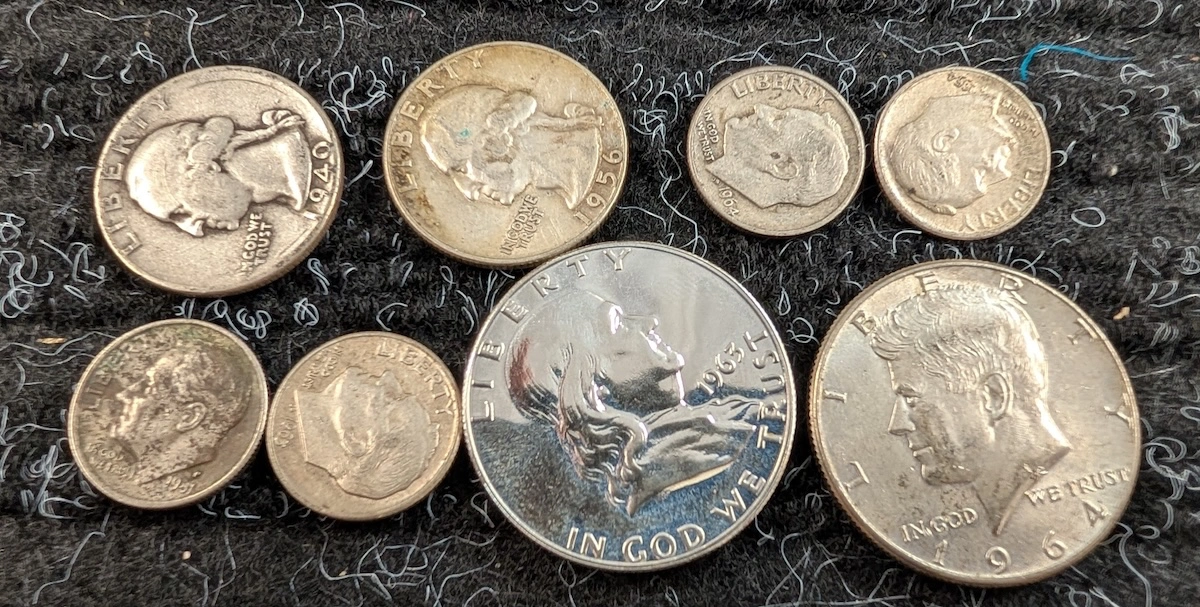
When people talk about 90% silver, they are usually referring to U.S. dimes, quarters, and half dollars dated 1964 and earlier. These coins were struck from an alloy containing 90% silver and 10% copper.
Because the coins are not pure silver, the total weight of the coins is greater than the amount of silver they contain.
Why Does $1.40 Face Value Equal One Ounce?
A combination of silver dimes, quarters, and half dollars with a total face value of $1.40 originally contained just over one troy ounce of silver when the coins left the U.S. Mint.
That is where the $1.40 figure comes from. Over the years, it became a simple shortcut that silver investors, coin dealers, and bullion buyers could easily remember.
For example:
- 14 silver dimes
- 5 silver quarters and 1 silver dime
- 2 silver half dollars, 1 silver quarter, and 1 silver dime
All equal $1.40 face value and contain approximately one troy ounce of silver.
This relationship is also why dealers commonly describe bags and groups of 90% silver by their dollar face value rather than trying to convert every transaction into individual ounces. Our guide to why coin dealers use face value for 90% silver coins explains that convention in more detail.
Why Doesn’t $1.40 Face Value Weigh One Ounce?
This is where many people get confused.
The $1.40 rule refers to the amount of silver contained in the coins, not the total weight of the coins themselves.
Since 90% silver coins also contain copper, a pile of $1.40 face value silver coins will weigh more than one troy ounce when placed on a scale.
The silver content is approximately one ounce. The total coin weight is greater.
It is also important to remember that precious metals are measured in troy ounces, not ordinary household ounces. That difference creates another layer of confusion when people try to check silver calculations using kitchen or postal scales.
Why Do Dealers Count 90% Silver Instead of Just Weighing It?
Because U.S. silver dimes, quarters, and half dollars were manufactured to standardized specifications, the denomination itself provides a convenient way to calculate the expected silver content.
That makes counting face value practical for ordinary circulated 90% silver. Dealers can quickly count a group of coins, determine the total face value, and apply the current market rate.
Our guide to why coin dealers count silver coins instead of simply weighing them explains why this system is so common in the trade.
Is 90% Silver Cheaper Than Buying Silver Bullion?
This is often the real reason people ask how much 90% silver equals an ounce.
Many buyers are comparing 90% silver coins to silver bullion, silver rounds, or silver bars. They want to know if old silver coins provide a cheaper way to own silver.
The reality is that the market already understands how much silver these coins contain. Dealers, wholesalers, refiners, and investors all calculate the silver content when buying and selling.
Sometimes 90% silver trades at a premium. Sometimes silver rounds or bars offer a better value. The relationship changes depending on market conditions, supply, demand, and investor interest.
There is no permanent advantage built into 90% silver simply because it comes in the form of old U.S. coins.
Not Every Silver Coin Uses the $1.40 Rule
The $1.40 shortcut applies to the traditional group of 90% silver U.S. dimes, quarters, and half dollars. It should not be used for every silver coin.
Morgan and Peace silver dollars, for example, contain approximately 0.7734 troy ounces of silver each. They have their own silver-content calculation and may also carry collector premiums. You can read more in our guide to how much silver is actually in Morgan and Peace dollars.
Buying and Selling 90% Silver Coins
Whether you are buying or selling 90% silver, dealers generally focus on the face value of the coins, the silver content, current market prices, and wholesale demand.
At Oakton Coins & Collectibles, we regularly buy and sell U.S. silver coins, silver dollars, silver bullion, gold bullion, jewelry, paper money, and inherited collections.
The Bottom Line
The traditional rule is simple: $1.40 face value of pre-1965 U.S. 90% silver coins equals approximately one troy ounce of silver.
It is a useful way to understand silver content, but it is not a shortcut to buying silver below market value. Whether silver is in the form of old dimes and quarters, modern bullion rounds, or silver bars, the market already accounts for the amount of silver contained in each product.
If you have questions about buying or selling silver coins in the Chicago area, visit Oakton Coins & Collectibles or learn more about our gold and silver bullion services.
Related Articles: Why Coin Dealers Use Face Value for 90% Silver Coins, Why Do Coin Dealers Count Silver Coins Instead of Weighing Them?, Troy Ounces vs. Regular Ounces, Are Morgan and Peace Dollars One Ounce of Silver?, Selling U.S. Silver Coins, Browse All Selling Guides