Every week at Oakton Coins & Collectibles, we meet people who unknowingly purchased counterfeit coins.
Some bought them online. Others found them at flea markets, swap meets, garage sales, social media marketplaces, or from private sellers. Occasionally someone drives hours to visit us, convinced they found something valuable, only to discover that every coin is counterfeit. Our guide to buying gold and precious metals from private sellers explains why these transactions can carry risks that are easy to underestimate.
Recently, one customer drove nearly three hours to our shop with a group of coins he had purchased from a private seller in Mexico. Unfortunately, every one of them was fake.
Counterfeit coins are a real problem in the coin market
Modern counterfeit coins are produced in enormous quantities. Many are made overseas and sold as cheap replicas, tokens, or novelty pieces. From there, they often get resold through other channels until they reach someone who believes they are genuine coins.
Years ago, counterfeiters mostly copied rare and expensive coins. Today, we see counterfeit Morgan dollars and Peace dollars, fake gold coins, fake silver coins, fake bullion coins, and even counterfeit copper coins. The same problem exists with bullion products, and fake gold bars bought online are becoming increasingly common.
If someone is willing to buy it, someone is willing to fake it.
-
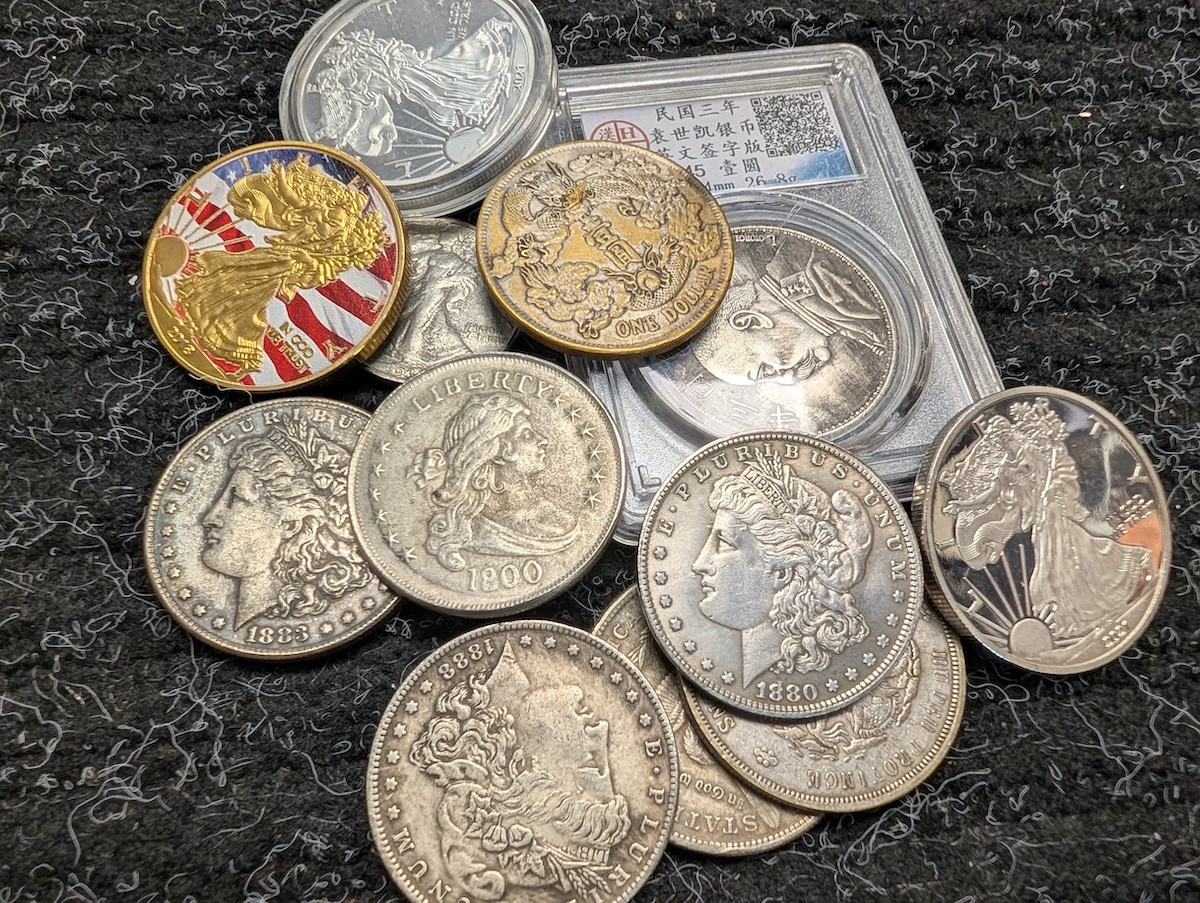
- Every counterfeit coin shown in the photographs above was brought into Oakton Coins & Collectibles by actual customers. These coins are shown for educational purposes only and are not for sale. We photographed them to help educate collectors and families because counterfeit coins have become far more common than many people realize.
Why we cannot price every coin over the phone
One reason we do not give firm prices over the phone is that we first have to determine exactly what we are looking at.
Before we can make an offer, we need to know whether the coin is genuine, altered, cleaned, damaged, plated, counterfeit, or made from the correct metal. Authentication comes before pricing.
This is especially important with collections brought in by people who are not experienced collectors. A coin may look exciting in a photo, but photos do not show weight, diameter, thickness, edge details, metal content, or many of the other things professional dealers check.
If you are planning to sell coins, you can learn more about our process on our sell coins page, our what we buy page, and our free appraisal page.
Coin identification apps are entertainment, not authentication
Coin identification apps should be viewed as entertainment tools, not authentication tools.
They may identify what a coin resembles, but they cannot determine whether a coin is genuine, counterfeit, altered, cleaned, repaired, plated, or made from the correct metal.
A counterfeit coin can produce the same identification and value estimate as a genuine coin because the app is comparing a photograph to a database. It is not authenticating the coin.
Every week we meet people who arrive convinced they own an extremely valuable coin because an app gave them a large number. In reality, many of those coins are modern counterfeits, common coins, damaged coins, or coins with little collector value. This is similar to the broader problem we discuss in our guide to why coin values on the internet are often misleading.
An app can tell you what a coin resembles. It cannot tell you whether the coin is real.
Professional dealers use experience and equipment
Professional coin dealers spend years learning what genuine coins should look like. We also invest in expensive equipment to help detect counterfeits and confirm metal content.
Depending on the coin, we may check weight, diameter, thickness, edge details, magnetism, metal composition, strike characteristics, surface texture, and other diagnostic features.
At Oakton Coins & Collectibles, we use professional testing methods, including precision scales, magnification, magnets, and XRF precious metal analysis when appropriate. You can read more about our shop on our accredited coin dealer page.
For expensive coins, third-party grading services such as PCGS, NGC, and PMG can also play an important role. We are a PCGS, NGC, and PMG authorized dealer and can help explain when professional grading makes sense. We also wrote more about that here: some coins have to be graded.
Be careful buying coins from non-traditional places
Coin shops and reputable coin shows are usually much safer places to buy valuable coins than flea markets, random online sellers, social media listings, or private sellers you do not know.
That does not mean every coin outside a coin shop is fake. You can certainly find inexpensive collectible coins, wheat pennies, foreign coins, or small items in casual places.
But genuinely expensive coins rarely sit on a flea market table anymore. The internet changed the market. Most people who inherit valuable coins can quickly find a professional coin shop, auction house, or experienced dealer.
The days of finding a five-figure coin for $20 at a flea market are mostly gone. Today, the more common story is someone paying too much for a modern counterfeit.
Counterfeits hurt the entire hobby
Counterfeit coins are bad for collectors, dealers, and the coin hobby as a whole.
They waste time, create confusion, reduce confidence in the market, and hurt people who were simply trying to buy something interesting. A few dishonest sellers profit while everyone else pays the price through extra caution, extra testing, and lost trust.
In that sense, counterfeiting is similar to stealing from a store. The person doing it may profit for a moment, but the cost spreads through the entire system.
Can you sell counterfeit coins to a dealer?
No.
Professional coin dealers carefully examine the coins they purchase. Counterfeit coins cannot be purchased as genuine coins, and knowingly selling counterfeit coins as genuine is illegal.
The United States Mint, United States Secret Service, and organizations such as the American Numismatic Association have all warned collectors about counterfeits in the marketplace.
Unfortunately, enforcement can be difficult, especially when counterfeit items are made overseas, sold as replicas, and then resold by other people.
Counterfeiters only need to fool one buyer
One of the biggest dangers with counterfeit coins is that they often are not discovered right away. A fake coin may be purchased, placed in a safe deposit box or home safe, and forgotten for years or even decades. By the time it is finally brought to a professional dealer for appraisal, the original seller may be impossible to trace, and the current owner may have no idea the coin is counterfeit. We see this with inherited collections as well as coins that were purchased many years earlier. Counterfeiters do not need to fool experts forever—they only need to fool one buyer.
There is a reason coin dealers exist
Buying and selling valuable coins outside the professional coin trade can feel like the Wild West. Without experience, it is very hard for the average person to separate genuine coins from convincing counterfeits.
Professional dealers are part of the trust system of the hobby. We authenticate coins, explain what they are, stand behind what we sell, and help protect collectors from costly mistakes.
If you have coins and are unsure whether they are real, bring them to Oakton Coins & Collectibles. We will examine them in person and explain what we see.
We are located in Skokie and regularly work with customers from Chicago, Evanston, Niles, Glenview, Rogers Park, Lincolnwood, and the surrounding area.
For more information, visit our selling guides, our FAQ, or our contact page.
Related Articles: Buying Gold and Precious Metals From Strangers, Fake Gold Bars Bought Online Are Becoming More Common, Some Coins Have to Be Graded, Coin Shop vs. Coin Show, Why Coin Values on the Internet Are Often Misleading, Browse All Selling Guides