We are starting to hear a new phrase from customers: “AI told me.”
People are uploading photographs of rings, necklaces, diamonds, coins, silver, and other jewelry to artificial intelligence tools and asking whether the items are real and what they are worth. It is an interesting idea, but AI was not designed to physically evaluate jewelry.
The results are not always completely right or completely wrong. More often, they are misleading. The answer may sound reasonable and authoritative while being based on incomplete information, a misread hallmark, or details the photograph could never show.
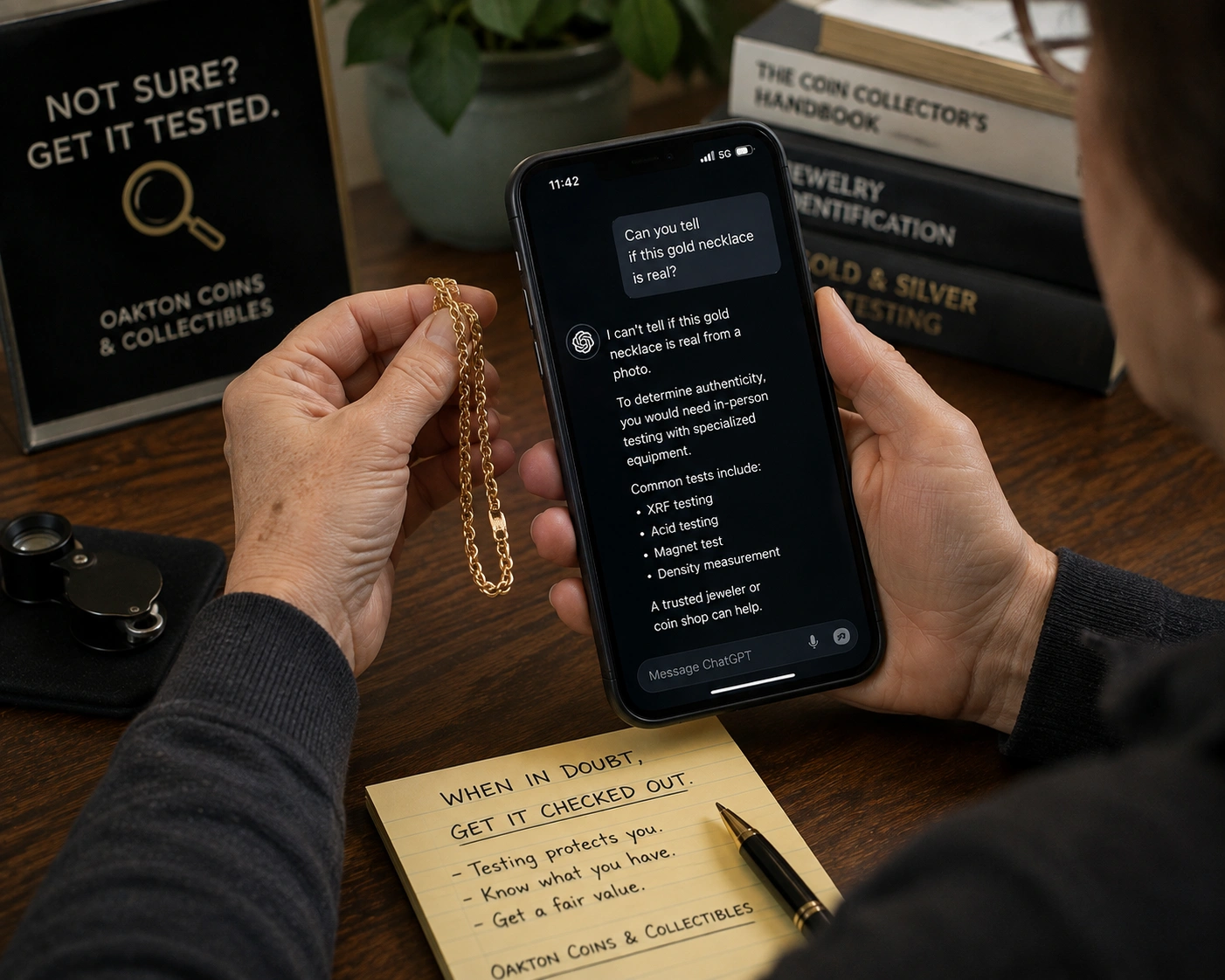
A Photograph Is Not a Jewelry Test
We recently examined a ring with extremely small lettering inside the band. The stamp appeared to read “10 Karat High Grade Electro Plate.” The AI looking at the photograph misread the marking, invented additional information, and identified it as a 10-karat gold ring made in Thailand. It then gave the owner a value.
The ring was plated, not solid 10-karat gold.
That is a major difference, but it is also an understandable mistake when a system is trying to interpret tiny, worn lettering from a photograph. The problem is that the answer did not sound uncertain. It sounded like a conclusion. Our guide to how to tell if jewelry is actually gold explains why markings and appearance alone are not enough.
AI Answers Sound More Certain Than They Are
Many AI tools are designed to be helpful and provide direct answers. They can produce polished explanations that sound authoritative even when the available information is incomplete.
That can be especially dangerous with jewelry.
A blurry photograph may not show whether an item is plated, filled, hollow, repaired, counterfeit, or made from several different metals. A worn hallmark may be misread. A stone may resemble a diamond without being one. The AI may still attempt to provide an identification and price because that is what the user asked it to do.
Confidence is not the same thing as accuracy.
Some Questions Require Physical Measurements
Determining whether jewelry is genuine and what it is worth requires more than recognizing its appearance. Professional gold and precious-metal testing may be necessary even when an item has a clear-looking hallmark.
Professional evaluation may require:
- Very accurate scales
- Magnification with a jeweler’s loupe or microscope
- Magnets
- Precious-metal testing
- XRF analysis
- Diamond and gemstone testing
- Measurements of stones and settings
- Current precious-metal prices
- Market data for diamonds, jewelry, watches, coins, and collectible pieces
- Experience recognizing repairs, plating, filled jewelry, misleading hallmarks, and unusual construction
None of this information can be extracted reliably from a photograph alone.
Artificial intelligence can only work with the information it has been given. A professional evaluation involves gathering information the owner may not have.
Even Correct Identification Does Not Produce an Accurate Value
Suppose AI correctly identifies a ring as 14-karat gold. It still does not know whether the ring weighs two grams or twenty grams. It does not know whether part of the weight comes from stones, steel springs, solder, resin, or other non-gold materials.
It may recognize something that looks like a diamond ring, but it cannot reliably determine from a photograph whether the stone is a natural diamond, lab-grown diamond, moissanite, cubic zirconia, glass, or another gemstone. Even after a diamond is properly identified, diamond resale values can vary substantially depending on the stone and current market.
It may recognize a gold coin in a necklace, but it cannot determine whether the coin is genuine, damaged, common, rare, removable from the setting, or worth more than its gold content. Counterfeit coins are more common than many people realize, and authentication cannot be reduced to matching a photograph.
Without accurate weight, purity, testing, and market information, any price is largely a guess.
AI Can Be Wrong in Either Direction
Other dealers and jewelers have told us they are hearing similar stories. Customers have been told by AI that real diamonds are fake, gold is silver, silver is gold, plated jewelry is solid gold, and genuine jewelry is costume jewelry.
Sometimes AI overvalues an item. Other times it dismisses something valuable.
The second mistake can be much more serious.
People are beginning to make real decisions based on these answers. Some have considered donating, discarding, or selling gold and diamond jewelry cheaply because an AI tool told them it was costume jewelry.
If AI tells you that your grandmother’s diamond ring is fake, do not donate it just yet.
Can You Test Jewelry at Home?
There is nothing wrong with examining your own jewelry if you are curious. A basic magnet can help separate some obvious costume jewelry, and a jeweler’s loupe may help you read markings more clearly than a phone photograph.
However, not everything can be done accurately at home.
Magnets do not prove that something is gold. Hallmarks can be fake, worn, incomplete, or misunderstood. Home acid testing can damage jewelry and may still produce confusing results. Consumer scales may not be accurate enough for small items, and most people do not have the equipment needed to test diamonds, plated pieces, unusual alloys, or mixed-metal jewelry.
You could spend hours uploading photographs, comparing answers, reading hallmark charts, and purchasing testing supplies. There is nothing wrong with doing that, but it is usually unnecessary.
That Is What We Are Here For
At Oakton Coins & Collectibles, we evaluate jewelry in person and test it with professional equipment. We have accurate scales, XRF analyzers, magnification, diamond-testing equipment, current market data, and years of experience handling gold, silver, platinum, diamonds, coins, watches, and estate jewelry. We do this for you at no charge.
You do not need to become an expert in precious metals, hallmarks, diamonds, or jewelry construction just to find out what is in your jewelry box. Bring the items to us, and we will help determine what they are and explain how we arrived at the answer.
AI can be useful for learning general terminology or getting ideas about what an item might be. But when the answer depends on weight, purity, authenticity, physical construction, or gemstone testing, a photograph is not enough.
There is a difference between a confident guess and a professional evaluation. Jewelry deserves the second.
Related Articles: How to Tell If Jewelry Is Gold, How Gold Is Tested, Diamond Resale Values Have Changed, Counterfeit Coins Are More Common Than Most People Realize, Best Place to Sell Gold in Chicago, Browse All Selling Guides