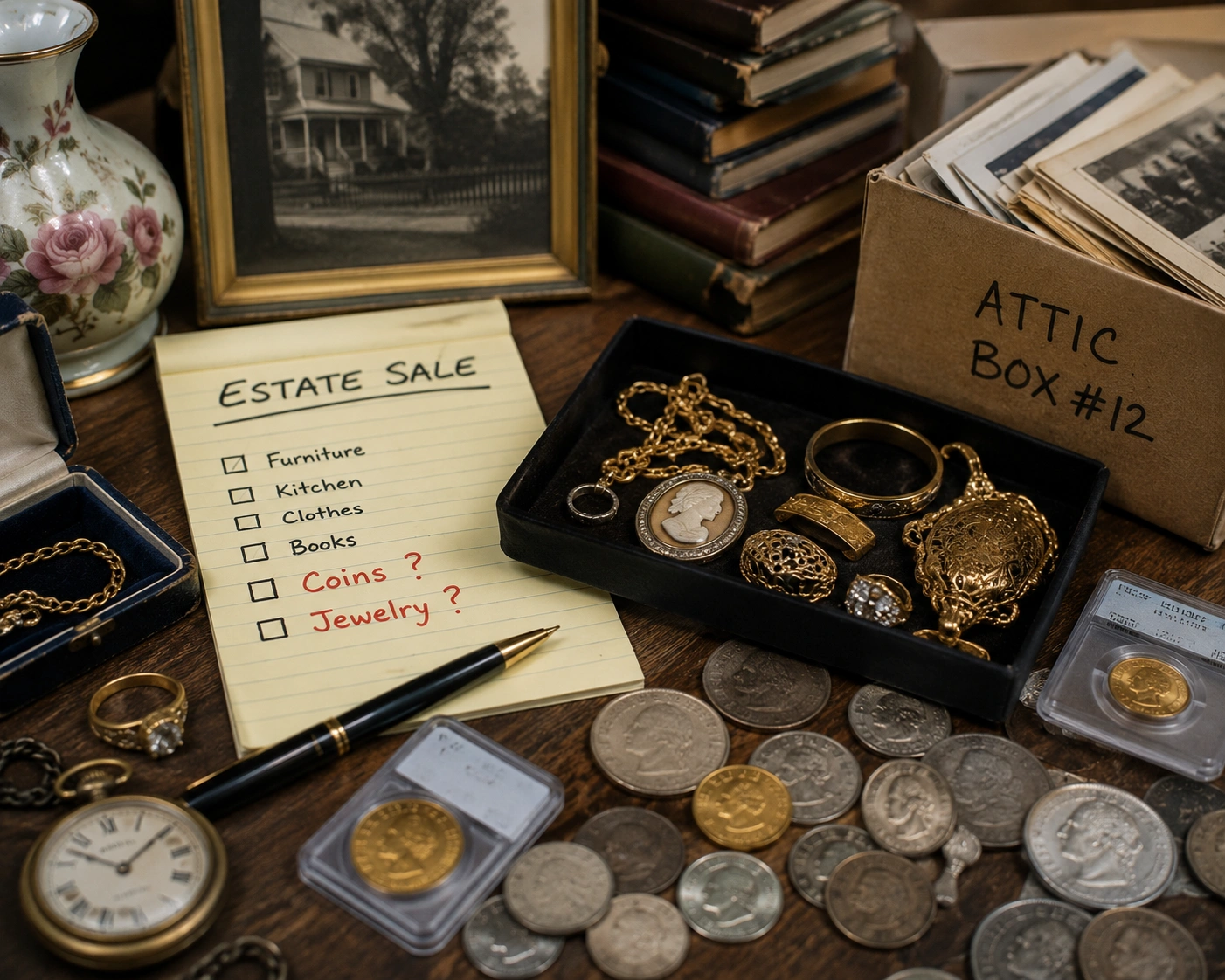
When a family is clearing out an estate, the house usually becomes the main focus. It is often the largest asset, and there may be pressure to empty it, clean it, list it, pay expenses, settle debts, or accept an offer quickly. The car may also receive immediate attention. Meanwhile, the coins and jewelry can look like just a few small boxes mixed in with decades of ordinary belongings.
Those small boxes deserve a little extra attention before the garage sale, estate sale, donation pickup, or cleanout begins. Coins and jewelry are two categories where value can be difficult to recognize without experience and proper testing. Gold jewelry may be tangled together with costume jewelry. Valuable coins may be mixed with common foreign money, old tokens, medals, or ordinary pocket change. Even when most of it is not valuable, it is important to identify the exceptions before anything is sold for a few dollars, donated, or thrown away.
At Oakton Coins & Collectibles, we see people bring in both valuable and ordinary material every day. Most estates do not contain a hidden fortune, but several times a year we meet families whose coins, bullion, or gold jewelry provide meaningful financial breathing room. We have seen boxes of jewelry and coin collections produce enough money to cover immediate estate expenses and give a family more time to make thoughtful decisions. In some cases, that has meant they did not feel pressured to accept the first offer on a house simply because cash was needed quickly. Sometimes selling part of an estate can give a family time to preserve or properly handle the rest.
One Valuable Box May Lead to Another
Another pattern we see is that one valuable discovery often gives the family time and motivation to look more carefully. Someone may bring in one box of coins or jewelry that turns out to be worth $10,000 or more. That does not happen in every estate, but when it does, the family often goes back through the home and begins finding additional boxes, envelopes, drawers, or small collections they had overlooked.
Collectors do not always keep everything together. Coins, jewelry, and precious metals may be stored in desk drawers, filing cabinets, safes, closets, toolboxes, basement shelves, old luggage, dresser drawers, books, kitchen containers, or other places that seemed secure at the time. Sometimes the owner intentionally hid items and never told anyone. Other times, things were moved over the years and simply forgotten.
This is especially true in houses where someone lived for 30, 40, or 50 years. Long-term homes can contain items accumulated across several generations. A person may have purchased a few gold coins decades ago, inherited silver dollars from a parent, put jewelry away after a relative died, and stored each group in a different part of the house. By the time the estate is being settled, nobody else may know the full story. Families dealing with coins in this situation may also find our guide to identifying inherited coins useful.
Experienced Buyers Know What Gets Overlooked
It is also worth remembering that many people regularly attend garage sales, estate sales, flea markets, and auctions specifically to look for overlooked valuables. Some of them have spent years learning how to recognize gold jewelry, silver, collectible coins, watches, and other items that may appear ordinary to an untrained eye. They buy those items cheaply and often bring them to coin dealers, jewelers, refiners, or other specialists for resale.
There is nothing wrong with that. Their knowledge and experience are part of how they make money. But if you are settling an estate, it is better to know what you have before someone else recognizes it first. A professional estate evaluation can help prevent a valuable item from being priced like costume jewelry, ordinary pocket change, or garage-sale clutter.
Let Us Help Separate the Valuable Items From the Ordinary Ones
We understand that cleaning out an estate can be overwhelming and that families are often working under difficult time limits. You do not need to research every coin or piece of jewelry yourself. Set those items aside and let someone who handles them every day tell you what deserves attention and what does not. If you are acting as the executor or representative of an estate, our guide to how estate executors can handle coins and jewelry explains some of the practical considerations.
Most items may turn out to be ordinary, and that information is useful too. It allows you to move forward with the garage sale, donation, or cleanout without wondering whether something important was missed. We would much rather tell you that an item has little value than hear that a valuable coin, gold bracelet, or family collection disappeared during a rushed house cleanout.
For estates containing several different categories of valuables, Oakton Coins & Collectibles can also provide one place to evaluate and sell many estate valuables, including coins, bullion, jewelry, paper money, sterling silver and other collectible material.
The house may be the largest asset in an estate, but sometimes the smallest box is what gives a family enough time to handle the rest of the estate properly.