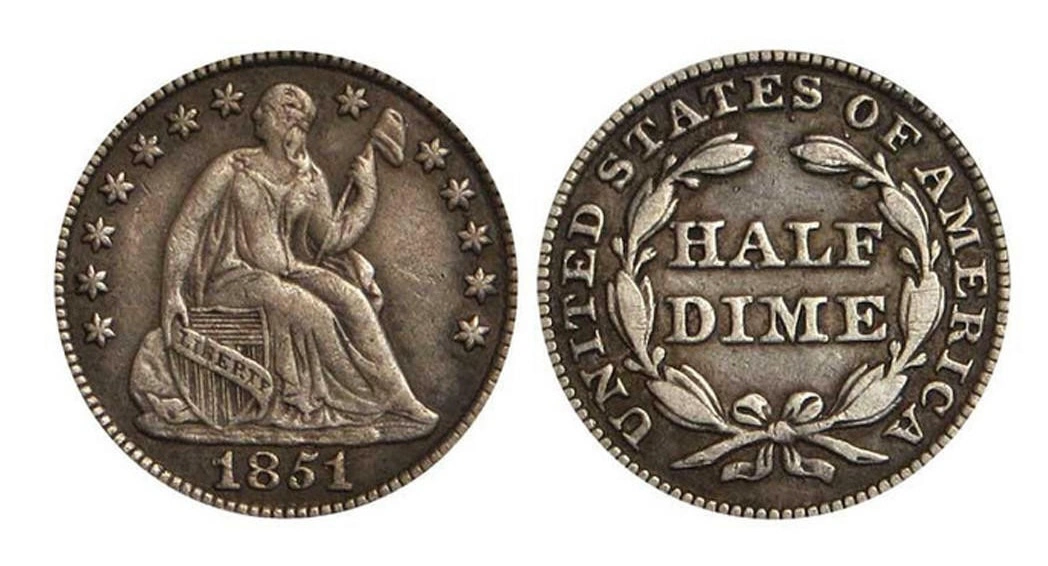
 What Is a Half Dime?
A half dime is exactly what the name suggests: a coin worth half of a dime.
A dime is worth ten cents, so a half dime was worth five cents.
The confusing part for modern collectors is that today we automatically associate five cents with the nickel. But “nickel” is really the nickname that developed for the later five-cent coin made with nickel metal.
The denomination itself is simply five cents.
The Half Dime Came Before the Nickel
The half dime was part of the American monetary system from its earliest years.
Half dimes were first produced in 1792, with regular federal coinage beginning shortly afterward. They were small silver coins and remained an important part of everyday U.S. coinage for much of the 19th century.
Over the years, the design changed several times. Collectors today may encounter Flowing Hair, Draped Bust, Capped Bust and Seated Liberty half dimes.
The later Seated Liberty half dimes are among the types most commonly encountered in old collections.
Why Did America Start Making Nickels?
The transition from the silver half dime to the nickel was not as simple as the government deciding to make the same coin out of a cheaper metal.
The Civil War created major disruptions in American coin circulation. Gold and silver coins were widely hoarded and disappeared from everyday commerce.
As the government searched for ways to keep small-denomination money circulating, Congress authorized a new five-cent coin made primarily from copper and nickel in 1866.
That new five-cent piece eventually became known simply as the nickel.
For Several Years, America Had Both
This is one of the strangest parts of the story.
The introduction of the nickel did not immediately eliminate the half dime.
From 1866 through 1873, the United States had both a silver half dime and a copper-nickel five-cent coin in existence at the same time.
Both coins had exactly the same face value: five cents.
One was a tiny silver coin called a half dime. The other was the newer copper-nickel coin that people increasingly called a nickel.
Why Did the Half Dime Disappear?
By the early 1870s, the larger copper-nickel five-cent coin had become the practical successor to the small silver half dime.
The Coinage Act of 1873 ended production of the half dime, bringing an important chapter of early American coinage to a close.
From that point forward, the copper-nickel five-cent coin became the standard American five-cent piece.
The denomination survived. The metal and the name changed.
So Is a Half Dime Basically an Old Nickel?
Not exactly.
A half dime and a nickel have the same face value, but they are different coins from different periods and made from different metals.
A half dime is a small silver five-cent coin. A nickel is the larger copper-nickel five-cent coin introduced in 1866.
Calling a half dime a nickel would therefore be historically inaccurate, even though both coins represent the same denomination.
Why Is the Half Dime So Small?
Another thing that surprises people is the size.
Half dimes are tiny. They are noticeably smaller than a modern dime.
That made sense under the older American coinage system, where the metal content of many silver coins was closely related to their monetary value.
A five-cent silver coin needed much less silver than a ten-cent dime, so the half dime was correspondingly smaller.
Once the United States moved toward base-metal five-cent coins, there was no need to keep the coin physically tiny.
Are Half Dimes Valuable?
Some are, but values vary tremendously.
The value of a half dime depends on factors including the date, mint, variety, condition and overall rarity.
Some later-date circulated half dimes are obtainable by collectors at relatively modest prices, while rare early issues and scarce varieties can be worth substantially more.
As with most old coins, condition can make an enormous difference. Two half dimes with the same date can have very different values depending on wear, damage, cleaning and eye appeal.
Don’t Clean an Old Half Dime
If you find a half dime in an old collection, resist the temptation to polish or clean it.
Cleaning an old silver coin can permanently damage its original surfaces and reduce its collector value.
Even a dark or heavily toned half dime may be more desirable to collectors in its original condition than after someone attempts to make it shiny.
Half Dimes Still Turn Up in Old Collections
Half dimes are more than 150 years old, but they still appear regularly in inherited collections, old coin albums, boxes of miscellaneous coins and family accumulations.
Because many people today have never heard of the denomination, they sometimes assume the tiny coin is foreign, damaged or incorrectly identified. If you’re going through a collection you inherited, our guide to identifying inherited coins explains why it is usually best not to make assumptions about unfamiliar pieces.
That is why the same conversation keeps happening:
“This is a half dime.”
“Don’t you mean a nickel?”
No. America really did have a half dime.
Have an Old Half Dime or Coin Collection?
Oakton Coins & Collectibles in Skokie buys and evaluates U.S. coins, including half dimes, early American silver coins, inherited collections, type coins and complete collections.
We offer free verbal evaluations and can help identify exactly what you have, whether the coins are common collector pieces or something significantly scarcer.
If you find an unfamiliar small silver coin in an old collection, don’t assume it is just an unusual dime or an old nickel. It may be a piece of the original American five-cent coinage system.