AI Can Sound Certain Without Finding an Actual Buyer
Artificial intelligence is very good at producing a polished explanation. It can identify a pattern, summarize its history, locate expensive online listings, and assemble a list of characteristics that might affect value. It can then present those facts as though they prove that a collector is waiting to buy the complete set.
They do not.
A description calling a pattern “popular,” “iconic,” or “highly collectible” is not an offer. An asking price is not a completed sale. A replacement dealer listing one teaspoon for a high retail price does not establish what that dealer—or anyone else—would pay today for twenty teaspoons and an entire service.
AI can describe a market that sounds convincing. A professional buyer must operate in the market that actually exists.
Replacement Prices Are Not Wholesale Purchase Prices
Replacement-flatware companies maintain enormous inventories so they can eventually sell one exact fork, spoon, or serving piece to someone completing a family service. They may hold a common pattern for years while waiting for that particular customer. Their individual-piece retail prices include the costs of identifying, sorting, photographing, storing, marketing, and waiting.
Those prices do not represent the immediate cash value of a complete set. In fact, when replacement sellers already have hundreds of pieces in the same pattern, that is evidence that the pattern is recognizable and plentiful—not scarce.
If an owner believes a collector will pay substantially more, the owner is free to locate that collector and complete the retail sale. But asking an immediate buyer to pay today for a hypothetical future customer transfers all the time, expense, and market risk to the buyer without establishing that the premium actually exists.
Ordinary Gorham Rarely Had a Dependable Premium
Even when silver traded near $15 per ounce, most ordinary American sterling flatware did not command a consistent wholesale premium in our market. Tiffany & Co. and Georg Jensen were among the limited names that sometimes had identifiable secondary demand, along with genuinely exceptional individual objects. Common Gorham flatware never did.
Today, even some Tiffany services are refined. The specialist network that once bought and sold certain premium makers has contracted severely. Many longtime participants retired, closed their businesses, or disappeared during and after the COVID period. In many cases, there is no longer a dependable wholesale buyer to call.
This is something an online search cannot easily measure. Old listings remain visible. Retail websites remain indexed. Auction estimates continue to circulate. But the people who once wrote checks for entire services may no longer be in the market.
High Silver Prices Change the Calculation
At historically elevated silver prices, the silver itself has overtaken the pattern as the primary source of value for most flatware. A collectible premium does not automatically rise along with the metal price.
If collectors were once willing to pay somewhat more than melt for a set when the silver was inexpensive, that does not mean they will increase their bids dollar-for-dollar as silver rises. Instead, the gap between collectible value and metal value becomes compressed and often disappears entirely.
Anyone who wanted an ordinary Gorham Chantilly service has had decades to buy one at much lower silver prices. There has not been a matching surge of households looking to purchase used formal sterling flatware at today’s metal values. Advising an owner to reject a historically strong and immediately available silver price while pursuing an unverified collector premium can be very poor advice.
Many “Treasured Sets” Were Never Used
We have opened countless flatware chests containing pieces that remained sealed in plastic for more than 30 years. These were not rare sets intentionally preserved by collectors. In most cases, the original owners simply never used them.
Even during the generations most closely associated with formal dinners and sterling table settings, a surprising amount of this material spent its entire life in storage. Younger generations have even less interest in polishing, storing, and using a formal service.
A complete set can be beautiful, well made, unmonogrammed, and virtually unused while still lacking a buyer above its silver value.
“Unmonogrammed” and “Unpolished” Do Not Create a Market
An unmonogrammed piece is easier to retail than one engraved with someone else’s initials. That can matters when a real retail customer exists. It does not, by itself, create that customer.
The same is true of tarnish described online as “natural patina.” Ordinary sterling flatware is routinely polished for use. Tarnish does not create a collector premium merely because it has accumulated over time. Condition matters if a piece has a genuine secondary market; condition cannot manufacture demand where none exists.
Hollow-Handled Knives Are Not Solid Sterling
AI-generated inventories often provide the gross gram weight of dinner knives and butter spreaders as though the entire weight were sterling silver. Most flatware knives have thin sterling handles filled with cement or another material and fitted with stainless-steel blades. Their gross weight cannot be valued as solid sterling.
Solid forks, spoons, and many serving pieces can be weighed and evaluated more directly. Hollow-handled pieces require a separate calculation based on their recoverable silver content. Learn more about how we evaluate weighted and filled sterling silver.
Refining Is Not Evidence That the Set Was Overlooked
Some owners are understandably uncomfortable hearing that a family flatware service may be purchased for refining. Refining does not mean the set was ignored, misidentified, or improperly evaluated. It means its strongest available market is the precious metal it contains.
Many families sold comparable sterling sets years ago when silver was worth half as much or less. Owners selling into today’s market are not losing a collector opportunity. They may be benefiting from one of the strongest silver markets of their lifetimes.
The relevant question is not whether a set is attractive, old, recognizable, or expensive on a replacement website. The question is whether a real buyer is presently willing to pay more than its recoverable silver value.
What We Look for When Evaluating Sterling Flatware
We examine the maker, pattern, hallmarks, construction, weight, condition, and current silver market. We also consider whether an actual secondary buyer exists. Exceptional Gorham work—including certain early, unusual, handmade, or important pieces—can deserve individual evaluation. That is very different from assuming every common Gorham service carries a premium because the company name is respected.
We test sterling in person and explain how the offer is calculated. For more information, visit our silver buying page or read about the limitations of AI-generated precious-metal valuations.
The Bottom Line
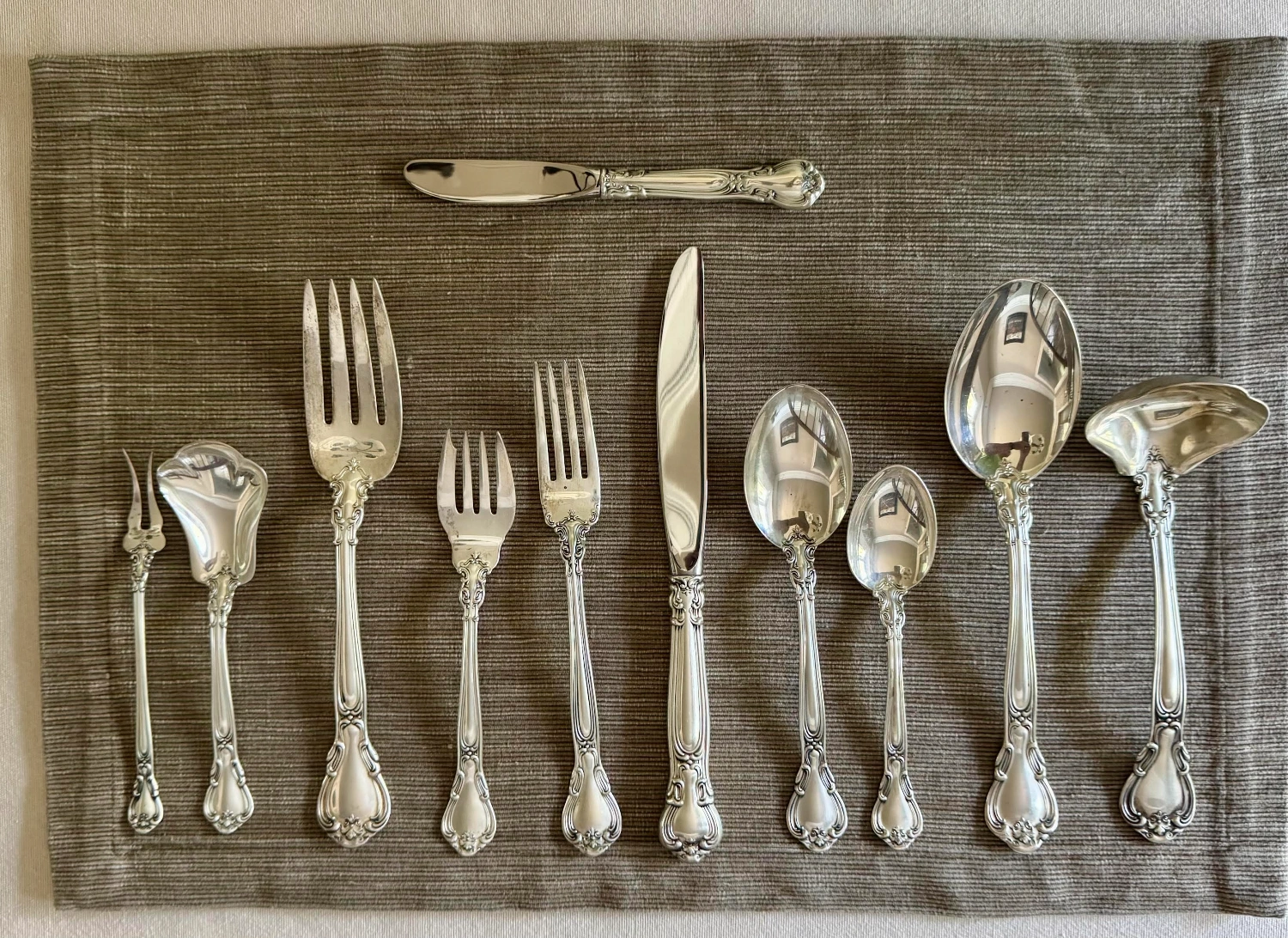
Gorham Chantilly is a famous and attractive pattern. It is also extremely common. Popularity, age, lack of monograms, and online replacement prices do not prove that a complete set has a collector premium in the present market.
AI may confidently recommend preserving the set and finding a collector, but confidence is not evidence. Until an actual buyer commits actual money, the suggested premium is theoretical. At today’s silver prices, the dependable commercial value of most ordinary Gorham flatware is its recoverable silver value.