Proof sets are among the most misunderstood items we see at Oakton Coins & Collectibles.
Some people bring in a proof set from the 1980s and are convinced it should be worth several hundred dollars. Other people look at the same coins and ask, “Isn’t this basically just shiny change?”
Both reactions are understandable.
Proof sets were deliberately made to look special. The coins have mirrored surfaces, sharp details, official U.S. Mint packaging, and often a certificate explaining what they are. They were popular birthday gifts, graduation presents, Christmas gifts, and birth-year keepsakes.
They are attractive collectibles. The problem is that many common proof sets were also produced in enormous quantities and carefully saved by nearly everyone who bought them.
Why We Call Them the Dead Years of Proof Sets
A proof coin is specially manufactured for collectors rather than for ordinary circulation. The dies and coin blanks receive additional preparation, and the coins are struck to produce sharper details and reflective surfaces.
That manufacturing process makes proof coins look different from the coins people carry in their pockets. It does not necessarily make them scarce.
For many years, the U.S. Mint produced large numbers of annual proof sets and sold them directly to the public. Collectors could order the new set each year, place it on a shelf, and continue the tradition the following year.
This became one of the easiest and most passive ways to collect coins. There was no need to attend coin shows, visit coin shops, search through pocket change, learn grading, or spend years trying to complete an album. The Mint simply mailed the newest set to your home.
Many people enjoyed that tradition, and there was nothing wrong with it. Some bought one set each year. Others bought five or ten, believing lower-production years might eventually become valuable. Some customers effectively treated annual Mint products like long-term investments.
My own grandfather thought about proof sets somewhat like stocks. He followed production figures and believed he could predict which years would be worth more ten years later. Twenty or thirty years ago, that idea was not as unreasonable as it may sound today. The market for modern Mint products was stronger, collectors closely watched annual mintages, and some lower-mintage issues did increase in value.
That success encouraged people to keep buying.
Over time, however, the supply became enormous.
We regularly see collections containing 50 or more proof sets. We have also handled estates containing hundreds or even thousands of U.S. Mint products. Many are still inside their original mailing boxes because the owner ordered them, placed them in a closet, and never opened them.
When family members inherit an entire closet filled with official Mint boxes, they naturally assume the collection must be worth a fortune. Why else would someone own so many or devote that much storage space to them?
In reality, the original owner may not have spent much time actively building the collection. The annual shipments simply accumulated.
There is a difference between carefully building a numismatic collection and accumulating annual Mint products. A traditional collector may spend years searching for rare dates, better grades, important varieties, or attractive examples for a complete set. A proof set buyer could simply purchase each year’s issue and add it to the shelf.
Both activities involve collecting coins, but they create very different kinds of collections.
The strongest proof set market generally exists for earlier sets, particularly those containing silver. Proof sets from the 1950s and early 1960s often look less impressive than later sets because they were sold in simple paper envelopes with the coins sealed in flexible plastic sleeves. Some earlier sets came in relatively plain boxes.
Ironically, these less elaborate-looking sets are often easier to sell because they contain 90% silver coins, were produced in lower quantities, and have stronger collector demand.
After silver was removed from most circulating U.S. coinage in the 1960s, the standard annual proof sets became primarily copper-nickel clad coins. For much of the 1970s, 1980s, and into the 1990s, the designs changed very little from year to year.
Around the shop, we sometimes refer to this period as the “dead years” of proof sets.
That is not an official numismatic term. It is simply our shorthand for a long stretch in which many common clad proof sets were heavily produced, widely saved, and eventually met with very limited collector demand.
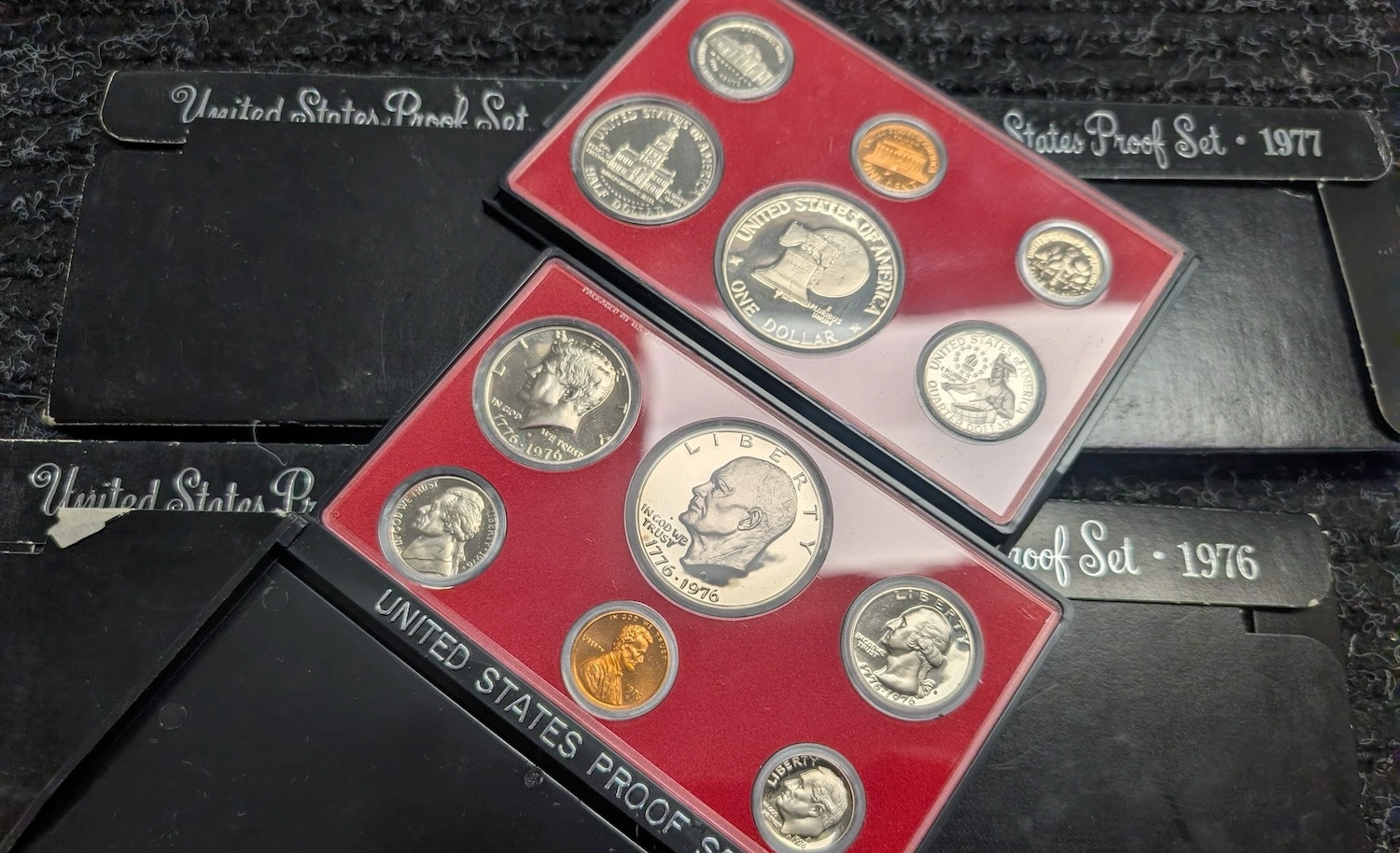
The problem is not quality. The problem is quantity.
Millions were made. Millions were preserved. Dealers, wholesalers, and collectors often already own more than they can reasonably sell.
From our experience, the imbalance can be extreme. For every several thousand common modern proof sets we have purchased, only a tiny number have eventually been sold individually to retail customers. Most must be moved through wholesale channels, sold in bulk, broken apart, or in some cases deposited as ordinary money when the wholesale value does not justify the labor and shipping expense.
There were periods when local wholesalers stopped buying common proof sets entirely because they already had too many. Dealers were filling tubs, shelves, and storage areas with sets that had almost no active market. We have purchased common clad sets at a discount to face value and eventually taken the coins to the bank because there was no practical buyer for the intact packaging.
Today, we do have wholesale outlets for many of these sets, but the margins remain extremely small. Shipping a heavy box of proof sets across the country only makes sense when the postage cost is unusually low or the sets can be packed efficiently. Even then, the amount received may not be much higher than the face value of the coins.
This is why dealer offers can surprise people. A customer may see a flawless official collectible that has been preserved for 40 or 50 years. The dealer sees an item that may sit in storage indefinitely and that hundreds of other dealers are also trying to move.
One of the biggest differences between the public and a dealer is perspective. If you inherit a 1984 proof set, it may be the only one you have ever handled. A dealer may have seen hundreds or thousands of identical sets.
That difference in perspective naturally creates very different expectations.
The U.S. Mint later expanded its product line and introduced separate silver proof sets. These contain silver versions of certain coins and generally have stronger intrinsic and collector value than standard clad sets.
At the same time, computerized engraving and modern manufacturing opened the door to many more designs, finishes, commemorative programs, quarter series, dollar programs, reverse proofs, special sets, and limited-edition products.
For decades, proof sets had changed very little. Then the Mint moved in the opposite direction and began producing an overwhelming number of different products. Many of the newer coins are beautiful, but collectors who attempted to buy everything suddenly needed much more money and storage space.
A person buying five or ten Mint products every year can quickly fill cabinets, closets, or entire rooms.
None of this means proof sets are bad collectibles.
They are often excellent gifts. A birth-year proof set can be an inexpensive and memorable present. I once pulled a proof set from a box because it matched my nephew’s birth year and gave it to him. He was genuinely excited about it. That is exactly the kind of thing proof sets are good at.
They preserve attractive examples of each year’s coinage, connect people with American history, and provide an easy entry point into the hobby. They were never required to become major investments in order to be enjoyable.
The misconception begins when people assume that official packaging, age, quantity, or decades of storage automatically produce high resale value.
They do not.
Value depends on silver content, mintage, surviving supply, current collector demand, condition, packaging, varieties, and the dealer’s ability to find another buyer.
We even keep an old numismatic “crying towel” in the shop. Early proof sets were sometimes accompanied by small pieces of cloth that collectors jokingly called crying towels. Depending on the customer, I may bring it out when someone is especially disappointed by the value of a common 1980s proof set.
Some people think it is funny. Some do not.
Either way, the underlying lesson is real: a coin can look special, remain untouched for decades, and still be common in the marketplace.
Common clad proof sets from the 1970s, 1980s, and much of the 1990s should be approached with realistic expectations. They may be attractive, genuine, and completely original, but they are also among the most overproduced and heavily preserved U.S. coin products of the modern era.
If you inherited proof sets, do not assume they are worthless. Some earlier sets, silver proof sets, lower-mintage issues, varieties, and specialty products can be worth considerably more than common clad sets.
At the same time, do not assume an entire closet of Mint boxes must represent a hidden fortune. Some of the most valuable collections we evaluate fit inside a small box. Some of the largest collections fill rooms.
Size and value are not always closely related.
Oakton Coins & Collectibles buys U.S. proof sets, silver proof sets, Mint sets, individual coins, complete collections, and inherited estates. We evaluate collections in person and explain which sets contain silver, which dates have stronger demand, and which products are common.
Learn more about selling coins, read our guide to identifying inherited coins, or visit our page about selling inherited and estate coin collections.
We are located in Skokie near Chicago and buy coin collections from customers throughout Chicago, Evanston, Niles, Morton Grove, Park Ridge, Lincolnwood, Wilmette, and the surrounding suburbs. Walk-ins are welcome, and free verbal evaluations are available during regular business hours.