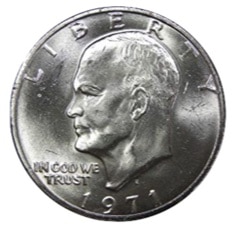
Generally, Eisenhower Dollars are worth one dollar.
We realize that may not be what you expected to hear. Like Bicentennial quarters, Eisenhower Dollars are surrounded by a surprising amount of internet misinformation. People often discover a large coin in a drawer, inherited collection, or old bank bag, search online, and quickly find claims that they are worth far more than face value.
The reality is that the vast majority of Eisenhower Dollars are common coins worth exactly one dollar.
Why Do People Think Eisenhower Dollars Are Silver?
Part of the confusion comes from the fact that some Eisenhower Dollars actually were made with silver.
The U.S. Mint produced special 40% silver collector versions between 1971 and 1976. These were sold directly to collectors and were not the standard coins used in circulation.
Most Eisenhower Dollars encountered today are the normal copper-nickel clad versions worth face value.
One quick way to check is to look at the edge of the coin. If you see a copper-colored band running through the edge, it is the standard clad version. If there is no visible copper band, it may be one of the silver collector issues and deserves a closer look. You can learn more about the types of U.S. silver coins we regularly encounter.
The Internet and Eisenhower Dollars
Much of the confusion surrounding Eisenhower Dollars comes from the same place as Bicentennial quarters: the internet.
People search for the coin and immediately encounter articles, videos, and online listings showing extraordinary values. What is often missing is the fact that those prices usually apply to unusual errors, rare varieties, exceptionally high-grade examples, or coins that have been professionally certified.
The ordinary Eisenhower Dollar sitting in a drawer is usually worth exactly one dollar. We discuss this issue in greater detail in our article on why coin values on the internet are often misleading.
An Example of Unsuccessful Money
One reason Eisenhower Dollars are so common today is that many people never really used them as money.
Money only works as money when it continues to circulate. If someone receives a dollar coin, decides it looks unusual, and puts it in a drawer for decades instead of spending it, that coin has effectively stopped circulating.
That happened to a lot of Eisenhower Dollars. People received them in change, thought they were interesting, and saved them. Not because they were rare, but because they were different.
As a result, countless Eisenhower Dollars ended up in jars, dresser drawers, coffee cans, inherited collections, and safe deposit boxes. The same basic lesson applies to many coins people save simply because they look unusual: unfamiliar or older does not automatically mean rare.
A Coin With an Interesting History
The Eisenhower Dollar was introduced in 1971 and was the first circulating U.S. dollar coin produced since the Peace Dollar ended in 1935. The coin honored President Dwight D. Eisenhower and also commemorated the Apollo 11 moon landing on the reverse.
The government hoped large dollar coins would see wider circulation, particularly in casinos and commercial transactions. While millions were produced, the public never fully embraced large dollar coins for everyday use.
Today, many people inherit Eisenhower Dollars alongside other common coins. If you are sorting through an inherited collection, our guide on how to identify inherited coins may be helpful. There is usually no need to research every coin individually before bringing in a collection.
What Do Coin Dealers Do With Them?
Most ordinary Eisenhower Dollars are simply treated as dollars.
Over the years we have seen countless examples come through the shop. We have used them as change, given them to children as tooth fairy money, and occasionally set them aside because people enjoy receiving them. They are a fun novelty because most people rarely encounter large dollar coins today.
That does not mean they are rare. Coin value depends on much more than age, size, or an unusual appearance, which is why our guide on whether old coins are worth a lot of money focuses on rarity, condition, demand, and metal content instead.
Bottom Line
Most Eisenhower Dollars are worth exactly one dollar.
Some collector-issued 40% silver examples are worth more, and a small number of rare varieties and exceptional-condition coins can command premiums. However, the overwhelming majority of Eisenhower Dollars found in circulation, inherited collections, and household drawers are common coins worth face value.
If you are unsure which type you have, start by checking the edge for a copper band. That simple test answers most Eisenhower Dollar questions in just a few seconds. You can also learn more about our numismatic coin expertise and the types of coin collections we evaluate every day.
Related Articles : Why Coin Values on the Internet Are Often Misleading, Are Old Coins Worth a Lot of Money?, Are Old Coins Rare?, Browse All Selling Guides