One of the most common things we hear at our coin shop is, “I looked it up online and it said my coin was worth thousands of dollars.”
Sometimes that is true. Most of the time, it is not.
The problem is not that people are doing research. We encourage people to learn about their coins. The problem is that search engines, videos, online marketplaces, coin apps, and AI tools often show the most exciting examples instead of the most typical examples.
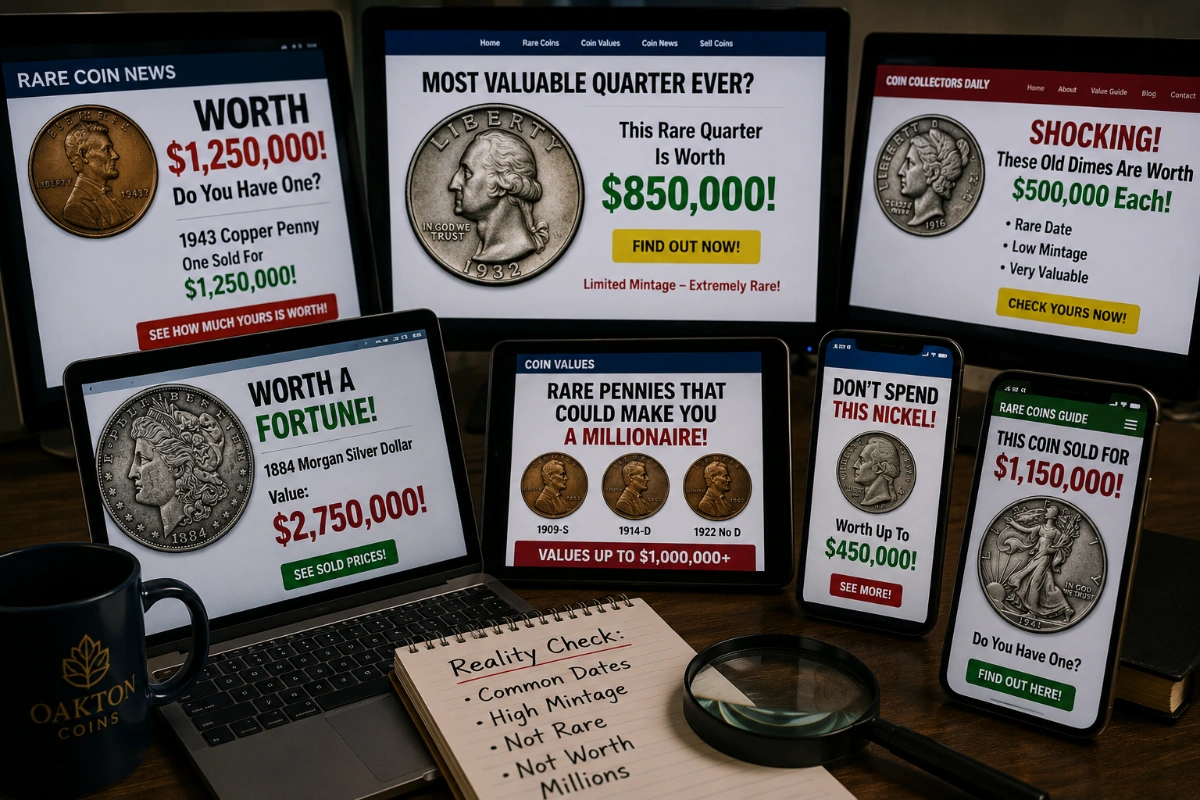
The Internet Loves Extreme Coin Values
Search engines are designed to show results people are likely to click on. Social media platforms are designed to keep people engaged. Online marketplaces are designed to show listings. AI tools often summarize whatever information is already floating around the web.
That creates a problem with coins.
If someone searches for a common coin, the internet may show rare varieties, mint errors, high-grade certified examples, or record auction prices. Those examples may be real, but they are usually not representative of the coin most people actually own.
Searching coin values online can be like searching for used cars and only being shown collector Ferraris. The cars are real, but they are not typical.
A Common Coin Can Look Rare Online
A person might search something simple like “1922 silver dollar value” and see an article, video, or listing about a rare example worth far more than a normal circulated coin.
But a better search might be “typical 1922 Morgan dollar value,” “common 1922 silver dollar value,” or “circulated 1922 Morgan dollar value.” Those searches are more likely to bring up realistic information.
The wording matters because the algorithm is trying to guess what you want to see. If your search sounds like you are looking for a valuable coin, it may show you valuable examples. That does not mean your coin is one of them.
Asking Prices Are Not Coin Values
Another major source of confusion comes from online marketplaces.
Anyone can list an Eisenhower dollar, Wheat penny, Kennedy half dollar, or other common coin online for almost any price they want. If someone lists a coin for $1,000,000, that does not mean the coin is worth $1,000,000.
It only means someone created a listing.
The seller could be joking. They could be guessing. They could be trying to get attention. They could simply be wrong.
What matters is not what someone asks. What matters is what similar coins actually sell for.
There Is No Coin Information Police
Many people assume that if something appears on Google, YouTube, Etsy, social media, or an AI answer, someone must have verified it.
That is not how the internet works.
Anyone can publish a website. Anyone can upload a video. Anyone can create a listing. Anyone can post a coin value. Some information is excellent. Some is terrible. Much of it is somewhere in between.
The internet often mistakes visibility for authority. Just because something appears high in a search result does not mean it is accurate.
From the Red Book to Google to AI
Older collectors often learned from printed references like the Red Book. They learned that coin values depend on date, mintmark, condition, rarity, demand, and sometimes metal content.
Today, many people start with Google, YouTube, social media, coin identification apps, or AI tools. Those tools can be useful, but they often do not teach the fundamentals first.
That is where the confusion begins.
I spent part of my career working with websites and search engines, and another part of my career buying and selling coins professionally. Watching those two worlds collide has been eye-opening.
The Red Book was built around organized information. The internet is built around attention. Social media is built around engagement. AI is often built around giving a quick answer. Those goals are not always the same as giving someone a realistic coin value.
Why This Makes Coin Shops Look Like the Bad Guy
We see this situation all the time.
Someone walks in excited because they believe a common coin is worth thousands or even millions of dollars. They are not trying to be difficult. In many cases, they really did spend time researching it online.
Unfortunately, what they found may have been a rare error, a perfect certified coin, an unrealistic asking price, or a clickbait article that had little to do with the coin in their hand.
Then the coin dealer has to explain that the coin is common. That can be disappointing, and sometimes it makes the dealer look like the bad guy.
But the real problem started before the person ever walked into the shop.
How to Research Coin Values More Realistically
When researching a coin online, try to look for typical examples, not extreme examples.
- Search for “common,” “typical,” or “circulated” values.
- Pay attention to completed sales, not just asking prices.
- Compare coins in similar condition.
- Be careful with videos or articles that focus on rare errors.
- Remember that old does not automatically mean rare.
The internet can be helpful, but it is not always realistic. It often shows the most interesting answer, not the most common answer.
The Bottom Line
Most coin value confusion online comes from one simple problem: people are shown the exception and assume it is the rule.
Rare coins exist. Valuable errors exist. Record auction prices are real. But most people do not have the rarest version of a common coin.
After more than a decade as a coin dealer, one of the hardest parts of the job is not identifying coins. It is helping people separate the coin they actually own from the rare coin the internet made them think they owned.
If you are unsure what you have, bring it to a knowledgeable coin dealer. A quick in-person look can often clear up what hours of online searching made confusing.
Related Articles : Why Coin Values on the Internet Are Often Misleading, Are Old Coins Worth a Lot of Money?, Are Old Coins Rare?, Why Coin Shops Cannot Pay Retail Prices, Selling Coins on eBay, Browse All Selling Guides