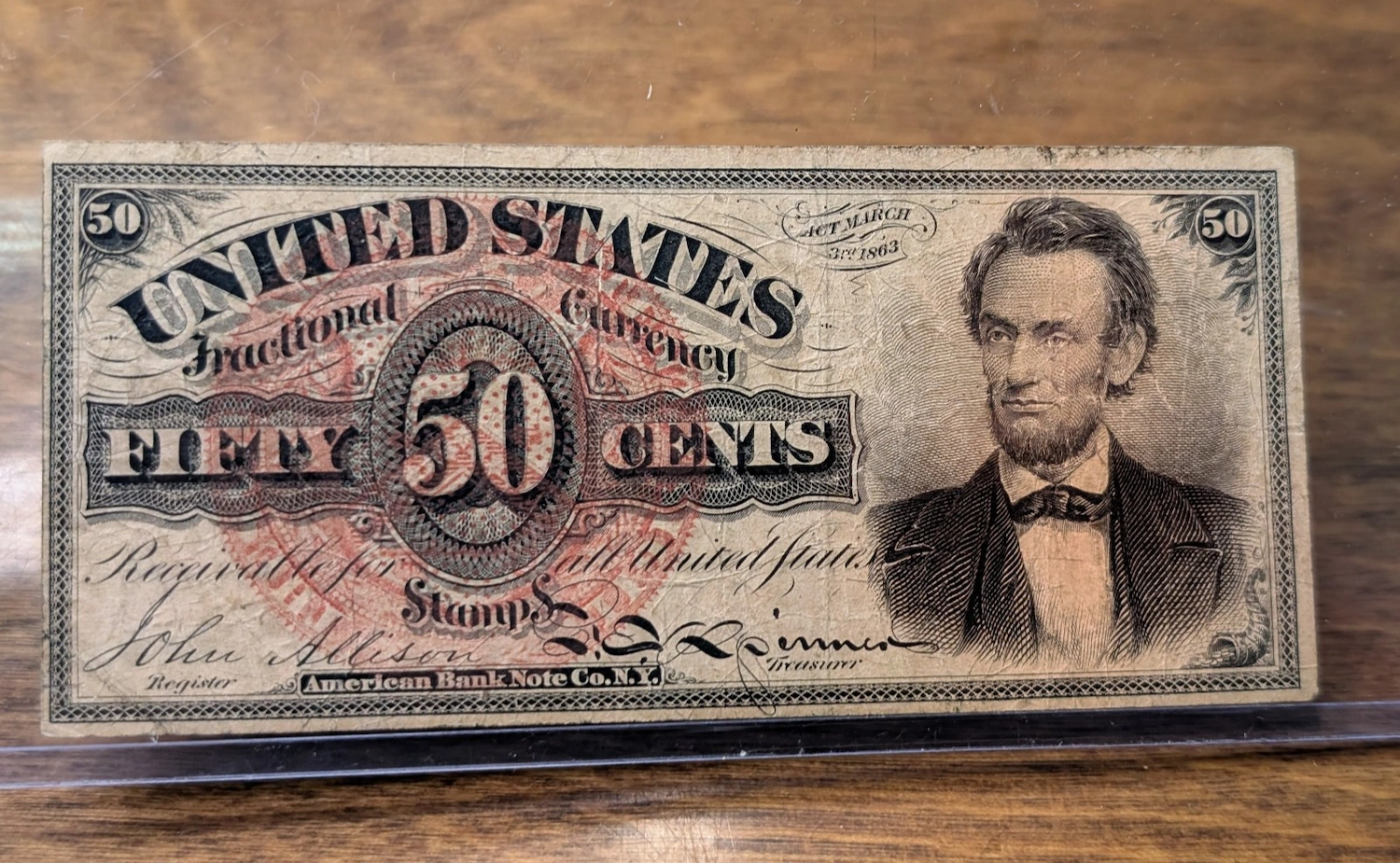
Why Did the United States Print Fractional Currency?
During the Civil War, coins began disappearing from circulation.
People hoarded gold and silver, and even small-denomination coins became difficult to find. That created a practical problem: how do you make change when the coins people normally use are no longer circulating?
The federal government responded by issuing small paper notes worth less than one dollar.
Postage Currency appeared first in 1862, followed by what became known as Fractional Currency.
These tiny notes were issued in denominations including 3 cents, 5 cents, 10 cents, 15 cents, 25 cents and 50 cents.
For someone accustomed to modern American money, a paper note worth three cents seems almost absurd. During the Civil War, however, it was a practical solution to a very real shortage of coins.
What Does U.S. Fractional Currency Look Like?
Fractional notes are generally much smaller than modern paper money and can look almost like miniature banknotes.
Different issues featured portraits, elaborate borders, colored printing and anti-counterfeiting devices.
Because there were several different series and denominations, fractional currency developed into a collecting specialty of its own.
Some examples are quite common, while others are scarcer and more desirable depending on the issue, variety and condition.
The Fractional Currency Shield
One of the most impressive items connected to fractional currency is the Fractional Currency Shield.
These large displays were created during the 1860s and contain examples of different fractional currency notes arranged around a central shield design.
They were distributed for reference purposes and helped banks, businesses and others recognize genuine notes and identify counterfeits.
We have a Fractional Currency Shield hanging on the wall at Oakton Coins & Collectibles. It is a great visual reminder of just how many different little notes Americans were using during the Civil War era.
What Is Confederate Currency?
At the same time the United States was issuing fractional currency, the Confederate States of America was producing an entirely different paper-money system.
The Confederacy needed enormous amounts of money to finance the war and issued notes in a wide range of denominations.
Confederate currency was backed largely by the expectation that the Confederacy would survive, win the war and eventually redeem the notes.
As the war continued and the Confederate economy deteriorated, inflation became severe and confidence in the currency collapsed.
When the Confederacy itself ceased to exist, the notes lost their monetary value.
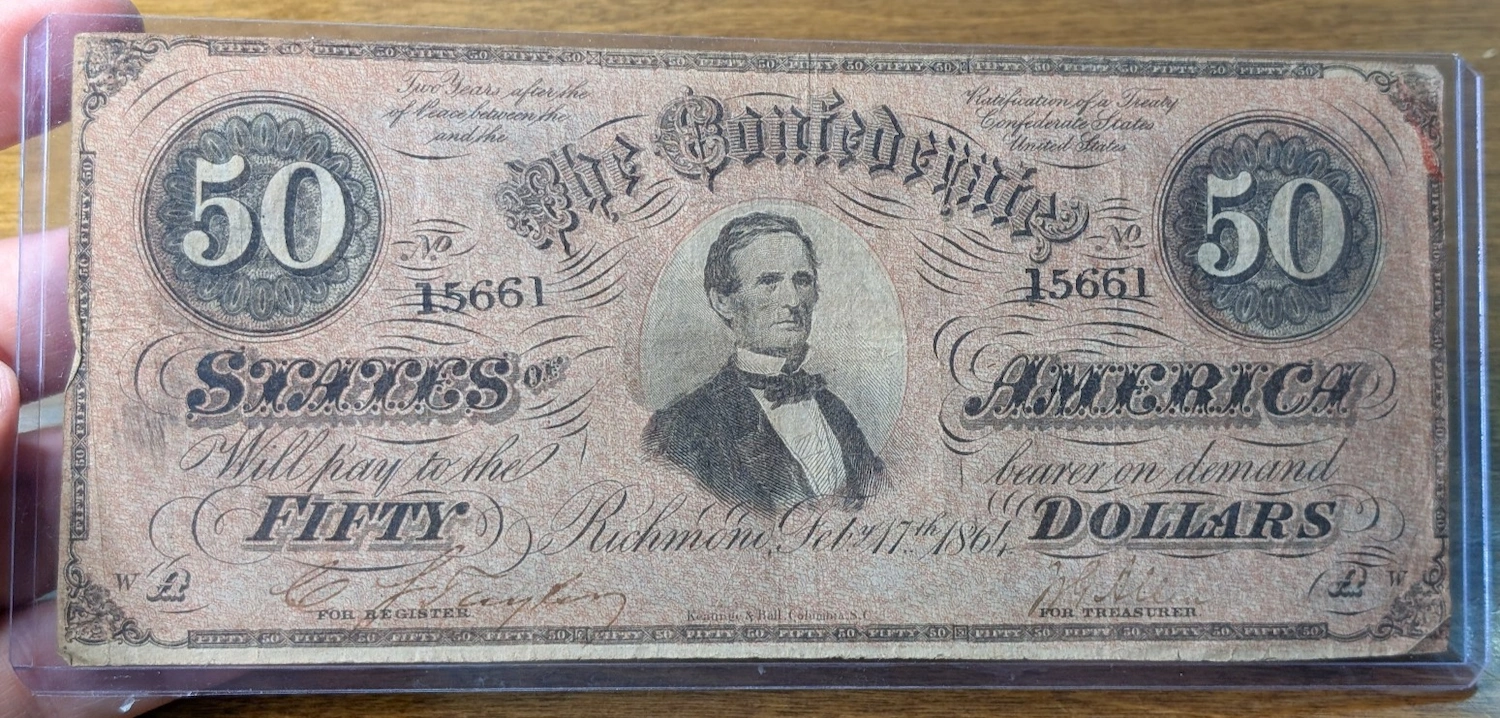
Why Does Confederate Currency Look So Different?
Many Confederate notes were produced under difficult wartime conditions and can look much less uniform than modern U.S. currency.
Different printers were used, paper quality varied, and many notes have handwritten serial numbers and signatures.
Some designs are elaborate and attractive. Others look surprisingly simple or crude by modern standards.
That uneven appearance is part of their history. The Confederacy was trying to finance a war while facing shortages, transportation problems, inflation and a rapidly changing economy.
Why Is There So Much Confederate Currency Left?
Large quantities of Confederate currency were printed during the war.
After the Confederacy collapsed, the notes were no longer useful as money, but people often kept them.
Some were saved as souvenirs. Others stayed in family papers, military collections, scrapbooks, trunks and envelopes for generations.
That is why genuine Confederate notes still appear regularly in inherited collections today.
Being from the Civil War does not automatically make a Confederate note rare.
Is Confederate Currency Valuable?
Confederate currency has an active collector market, and we regularly buy and sell it.
Values vary considerably depending on the issue, denomination, condition, variety, signatures and overall scarcity.
Some common Confederate notes are relatively inexpensive despite their age. Better varieties and scarcer issues can be worth considerably more.
Collector interest is particularly strong in the South, where these notes also have obvious connections to regional and family history.
For most families who inherit a small group of ordinary Confederate notes, however, it is best to think of them as interesting historical collectibles rather than a retirement fund.
What About Confederate Counterfeits and Reproductions?
Counterfeiting was a significant problem during the Civil War.
One famous example involves Samuel Upham of Philadelphia, who printed reproductions of Confederate notes that were initially sold as curiosities and souvenirs. Many ultimately found their way into the South and circulated as counterfeits.
There are also countless later reproductions and souvenir copies of Confederate currency.
This can create confusion for families because a reproduction itself may have been sitting in a drawer for 50 or 75 years. The fact that a note is old does not necessarily mean it was printed during the Civil War.
Some reproductions are obvious once you know what to look for. Others can require comparison with known genuine examples. The same basic authentication problem appears elsewhere in numismatics, and our guide on counterfeit coins and reproductions explains why age and appearance alone are not enough to establish authenticity.
Are Fractional Currency and Confederate Currency Rare?
Some individual notes are rare. Many are not.
This is one of the most important things to understand about old paper money.
Age alone does not determine value. The number originally printed, how many survived, the specific issue, condition and collector demand all matter.
A common Confederate note can be more than 160 years old and still be affordable. A scarcer fractional note from the same general period can be considerably more valuable.
The history is often remarkable even when the market value is modest.
Why Families Keep Finding Civil War-Era Money
Old paper money is easy to save.
Unlike furniture, tools or other large historical objects, a stack of notes can sit unnoticed in a small envelope for generations.
We frequently see fractional currency and Confederate notes mixed into inherited coin collections, military memorabilia, old documents and family papers.
Sometimes the family knows exactly where the notes came from. Other times, nobody has any idea how they ended up in the collection.
We Buy and Sell Fractional and Confederate Currency
Oakton Coins & Collectibles in Skokie buys and sells U.S. fractional currency, Confederate currency and other forms of obsolete and historical paper money. You can learn more about selling collectible paper money in the Chicago area.
We can help determine whether a note is genuine, identify the issue and denomination, evaluate the condition and explain whether the note is common or something more unusual.
We also buy larger collections containing mixed coins, paper money, Civil War material and other historical items.
If you inherit old fractional currency or Confederate notes, there is no reason to assume they are either worthless or extremely valuable before having them identified.
They may not pay for retirement, but they are genuine pieces of American history—and some are considerably more interesting than their price would suggest.
Related Articles: Who Buys Paper Money in Chicago?, Large Denomination U.S. Notes, Are $2 Bills Rare?, Counterfeit Coins Are More Common Than Most People Realize, Are Old Coins Rare?, Browse All Selling Guides