Finding a banknote with words crossed out, a new denomination stamped across it, or the name of another country printed over the original design can be confusing. It may look as though someone altered or damaged the note after it was issued.
Sometimes that is exactly what happened. People have written on banknotes, added souvenir stamps, created political messages, and applied unofficial markings for generations. In other cases, however, the alteration was made officially by a government or issuing authority. The stamp, cross-out, or overprint may be an important part of the banknote’s history.
Why Would a Government Alter Existing Banknotes?
Designing and printing an entirely new series of currency takes time and money. When a government needs new currency quickly, it may be more practical to modify banknotes that have already been printed.
Official overprints have been used for many reasons, including:
- Changing an old denomination into a new denomination
- Introducing currency after a change in government
- Adapting notes for use in a colony or overseas territory
- Responding to a temporary shortage of suitable currency
- Removing the name or symbols of a former government
- Reusing surplus banknotes originally intended for another location
- Marking currency as valid only within a particular region
These altered notes can provide a remarkably direct record of political, economic, and geographic change. Instead of quietly replacing the old money, the issuing authority sometimes leaves much of the original note visible and simply prints the new information over it.
A Banknote From Réunion Used Near Canada
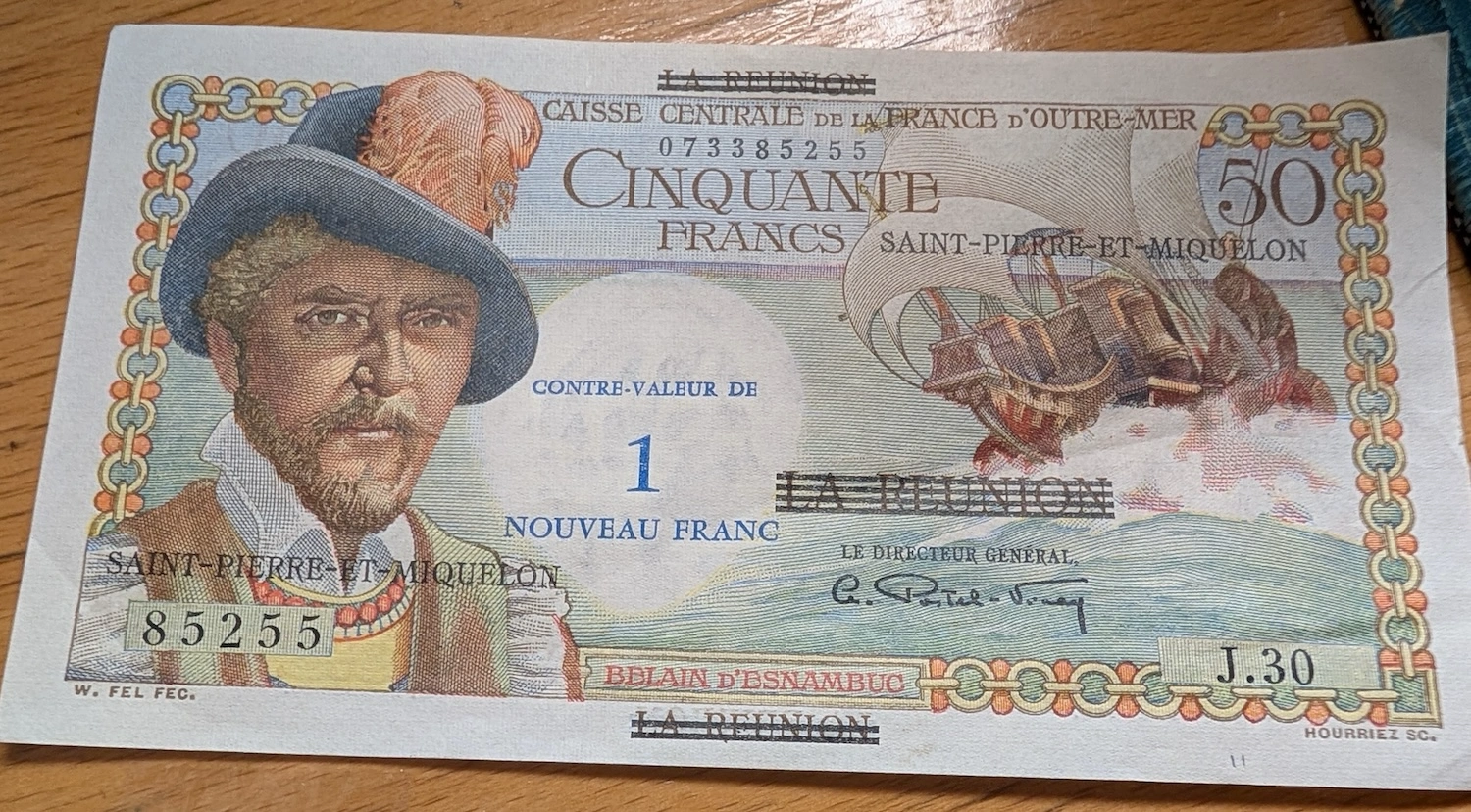
One especially unusual example is a 50-franc banknote originally printed for Réunion, a French island in the Indian Ocean east of Madagascar. On the altered version, the name “La Réunion” is crossed out in several places. The name “Saint-Pierre-et-Miquelon” is printed over the original design, and the old value is changed to the equivalent of one new franc.
Saint-Pierre and Miquelon is also French territory, but it is located on the opposite side of the world, just off the coast of Newfoundland, Canada. At first glance, it makes little sense for a Réunion banknote to have been used there.
The explanation is practical. France’s overseas currency authority had usable Réunion banknotes available and needed notes for Saint-Pierre and Miquelon during the 1960 currency reform. Under that reform, 50 old francs became one new franc. The original 50-franc notes could therefore be converted neatly into one-new-franc notes.
Instead of discarding the existing paper and printing a completely new issue, the authority crossed out “La Réunion,” added “Saint-Pierre-et-Miquelon,” and printed “contre-valeur de 1 nouveau franc,” meaning that the note had the equivalent value of one new franc.
The crossing-out was not graffiti, damage, or an informal cancellation. It was part of the officially issued note. Collectors generally identify this issue as a 1960 Saint-Pierre and Miquelon one-new-franc note overprinted on an earlier Réunion 50-franc note.
Why Didn’t Saint-Pierre and Miquelon Become Part of Canada?
The location can create another obvious question: Why did these small islands remain French when they are so close to Canada?
France and Britain fought over the islands several times during the eighteenth and early nineteenth centuries. Britain occupied them on more than one occasion, but they were ultimately restored to France in 1816 following the Napoleonic Wars. France valued the islands as a base for its fishing industry in the rich waters near Newfoundland.
By the time Canada became a country in 1867, Saint-Pierre and Miquelon was already recognized as French territory. The islands remain part of France today. Their residents are French citizens and use the euro, although their daily economic and transportation connections with nearby Canada remain important.
Does an Official Overprint Make a Banknote Valuable?
Not automatically. An unusual-looking overprint may make a banknote historically interesting, but value still depends on the exact issue and the number of surviving examples.
Important factors can include:
- The original banknote used beneath the overprint
- The country or territory that authorized the alteration
- The wording, color, position, and type of overprint
- Whether multiple overprint varieties exist
- The serial number and prefix
- The number originally issued
- The number believed to survive
- The condition of the banknote
- Whether the alteration is official, private, counterfeit, or modern
Two notes that appear nearly identical may have substantially different collector values because of a small change in the overprint, signature, serial-number prefix, or underlying note. Conversely, a dramatic-looking stamp does not guarantee rarity. Some officially overprinted notes were produced in large quantities and remain common today.
Official Overprint or Later Addition?
Determining whether an overprint is official can require more than looking at the note. Reference catalogs document recognized issues, but unofficial and counterfeit overprints also exist. In some cases, people have added markings to otherwise common notes in an attempt to make them look rare.
The printing method, ink, alignment, underlying banknote, serial number, and known varieties may all matter. It is generally best not to erase, clean, trace over, or otherwise “improve” any marking. If the alteration is original, attempting to remove it can destroy the very feature that makes the note collectible.
Selling Overprinted and Unusual Foreign Banknotes
At Oakton Coins & Collectibles, we examine foreign paper money, including individual notes, old collections, inherited albums, colonial issues, emergency currency, occupation notes, and officially overprinted banknotes. Some pieces have meaningful collector value, while others are primarily interesting historical artifacts with limited commercial demand.
You do not need to identify every note before bringing in a collection. Please avoid writing prices on the notes, attaching tape, using glue, laminating them, or attempting to clean them. If the notes are already in holders or albums, they can usually remain there until they are examined.
Oakton Coins & Collectibles is located in Skokie and serves customers throughout Chicago, Evanston, the North Shore, and the surrounding suburbs. Walk-ins are welcome, and no appointment is normally necessary. We can help separate genuinely collectible foreign banknotes from common material and explain what makes a particular issue interesting or valuable.
Related Articles: World Paper Currency, Japanese Occupation Money, Are Old Coins Rare?, Selling an Inherited Coin Collection, Browse All Selling Guides