Oakton Coins & Collectibles buys gold, silver, platinum, estate, designer and unwanted jewelry from customers throughout Chicago and the surrounding suburbs. We purchase everything from broken chains and single earrings to inherited collections, diamond rings and recognized designer pieces.
Our established Skokie storefront is located near Chicago’s northern border, making it convenient for customers from Rogers Park, West Ridge, Edgewater, Uptown, Albany Park, Lincolnwood and Evanston. Evaluations are completed in person, items are tested and weighed while you are present, and there is no obligation to sell.
You do not need an expensive diamond or famous designer name to visit us. Most of the jewelry people own is ordinary gold or silver jewelry, and those items can still have substantial value based on their precious-metal content.
Sell Jewelry Near Chicago With Clear In-Person Testing
Jewelry can be difficult to value because two pieces that look similar may contain different amounts of gold, different gemstones or completely different materials. Our job is to determine what each item actually is, explain how it is valued and make a straightforward offer based on the current market.
If you decide to sell, payment is made immediately. If you decide to keep the jewelry, there is no evaluation fee for a typical verbal assessment and no pressure to complete a transaction.

What Types of Jewelry Do We Buy?
We buy individual pieces, mixed jewelry boxes and complete inherited collections. Jewelry does not need to be fashionable, wearable or in perfect condition.
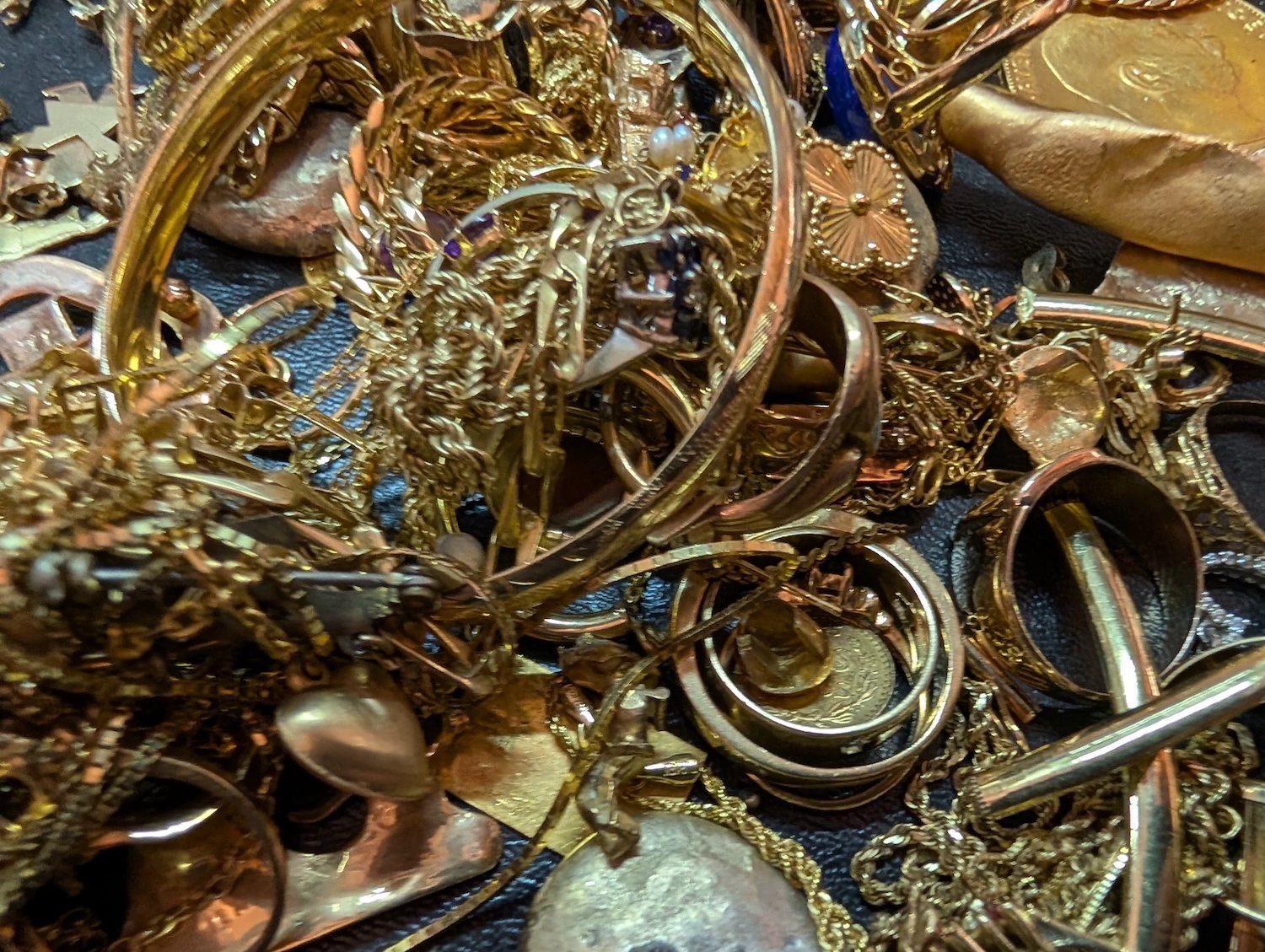
- Gold rings, necklaces, bracelets and earrings
- Broken or tangled gold chains
- Wedding bands and engagement rings
- Single earrings and mismatched pieces
- Gold charms, pendants and religious jewelry
- Gold watches and watch cases
- Diamond and gemstone jewelry
- Estate, antique and vintage jewelry
- Designer and signed jewelry
- Sterling silver jewelry
- Platinum jewelry
- Dental gold
- Jewelry with missing stones or damaged settings
- Unsorted and inherited jewelry collections
Our main jewelry buying guide provides additional information about the different categories we purchase.
We Buy Ordinary Gold Jewelry Too
Many Chicago jewelry buyers advertise primarily for large diamonds, Rolex watches or famous luxury brands. Those can be valuable, but they represent only a small portion of the jewelry most families actually own.
We regularly purchase ordinary 10k, 14k, 18k, 21k, 22k and 24k gold jewelry. It may have been purchased at a neighborhood jewelry store, received as a gift, inherited from a relative or accumulated over many years. A piece does not need a recognizable brand name to contain valuable gold.
Broken chains, old class rings, outdated wedding bands, bent bracelets, damaged settings and single earrings can all be evaluated. Learn more about selling broken jewelry.
How Gold Jewelry Is Tested
Gold markings provide useful information, but stamps are not always accurate. Jewelry may also contain solder, repairs, plated sections, clasps made from different alloys or multiple metals within the same piece.
Oakton Coins uses two benchtop X-ray fluorescence analyzers along with traditional testing methods when appropriate. XRF technology helps determine the elemental composition of jewelry without requiring every item to be filed or damaged.
Testing is performed in the shop while you are present. Items are sorted by purity, weighed and explained before an offer is made.
How Gold Jewelry Value Is Calculated
When jewelry is valued primarily for its gold content, the most important factors are:
- Total weight
- Actual gold purity
- Current gold market
- Weight attributable to stones or non-gold components
- Refining and processing requirements
- Current wholesale liquidity
A 14k stamp does not mean that the entire weight of a ring is pure gold. Fourteen-karat gold is approximately 58.5% gold, with the remainder consisting of other metals. Stones, springs, clasps and non-gold components may also be included in the total weight and must be considered separately.
Gold’s published spot price is an important reference, but it is not automatically the amount paid for a finished piece of jewelry. Our guide to the gold and silver spot price explains the difference between a market benchmark and an actual physical transaction.
Metal Value Versus Jewelry Resale Value
Most mass-produced jewelry is valued primarily for its precious-metal content. The original retail price may have included design, manufacturing, advertising, store overhead and a retail markup that does not transfer to the secondary market.
Other jewelry can be worth more intact. A recognized designer, unusual construction, desirable period style, important gemstone or strong resale market may justify a premium beyond the metal value.
We separate pieces that deserve individual consideration from jewelry that is most realistically valued for its gold, silver or platinum content. This prevents potentially desirable pieces from automatically being treated as recyclable metal.
Estate and Inherited Jewelry
Inherited jewelry often arrives as a mixed group rather than an organized collection. A single box may contain valuable gold, sterling silver, costume jewelry, plated pieces, watches, loose stones and items with sentimental but limited commercial value.
You do not need to sort everything before visiting. In fact, keeping an inherited group together can preserve useful information about where items came from and how they were stored.
We can separate the different categories, identify precious metals and point out pieces that may require additional attention. Learn more about selling estate and designer jewelry.
Designer and Signed Jewelry
Recognized designer jewelry can sometimes carry value beyond its gold or platinum content. We evaluate signed pieces individually based on authenticity, condition, model, age, completeness and current resale demand.
Designer names we may encounter include Tiffany & Co., Cartier, David Yurman, Bulgari, Van Cleef & Arpels and other recognized makers. Original boxes, receipts, certificates and service records can be helpful, but they are not always required.
A famous name does not guarantee a large premium. Some discontinued or unpopular designs trade close to their metal value, while desirable pieces from the same maker may have a much stronger secondary market. We evaluate the actual piece rather than assuming every branded item is equal.
Diamond and Gemstone Jewelry
We also evaluate diamond rings, loose diamonds and jewelry containing diamonds or colored gemstones. Diamond value depends on more than carat weight. Shape, color, clarity, cut quality, treatment, certification and current demand all influence what a stone can realistically sell for.
Natural diamonds with GIA or other recognized laboratory reports should be brought with their paperwork whenever available. Uncertified diamonds can still be examined, although additional evaluation may occasionally be required for larger or unusual stones.
Many small accent diamonds and common gemstones have limited resale value despite adding substantially to the original retail cost. When stones do not add meaningful value, they can often be removed and returned when practical.
Sterling Silver and Platinum Jewelry
Gold is not the only valuable metal found in jewelry. We also buy sterling silver and platinum rings, chains, bracelets, earrings and mixed collections.
Sterling silver is commonly marked STERLING, 925 or .925. Platinum may be marked PLAT, PT950, 900 PLAT or with another purity designation. Marks can be worn, incomplete or misleading, so uncertain pieces should still be tested.
Silver jewelry generally needs more weight to produce the same value as gold, but accumulated groups can add up. Visit our guide to selling sterling silver jewelry for more information.

Broken, Damaged and Outdated Jewelry
Condition usually does not eliminate the precious-metal value of jewelry. A broken necklace contains the same gold as an intact necklace of the same purity and weight.
We buy:
- Snapped and tangled chains
- Bent rings
- Bracelets with damaged clasps
- Jewelry missing stones
- Single earrings
- Worn or engraved wedding bands
- Outdated jewelry that is no longer worn
- Small fragments and incomplete pieces
There is no need to repair or polish jewelry before bringing it in. Repairs frequently cost more than the additional resale value they create.
Retail Appraisals Are Not Resale Prices
An insurance appraisal usually estimates the retail cost of replacing an item. It is not a prediction of what the jewelry can be sold for.
Replacement appraisals often include retail labor, store markup and the cost of finding a comparable new item. A jewelry buyer must instead consider what the existing piece or its components can sell for in the current secondary market.
Bring previous appraisals, receipts and certificates if you have them because they may contain useful information. However, the offer will be based on the jewelry itself and current market conditions rather than the number printed on an older appraisal.
What Happens During the Evaluation?
The process normally begins by separating jewelry according to metal type and purity. We examine markings, test uncertain items and determine whether any pieces deserve consideration beyond their precious-metal content.
Jewelry is then weighed and evaluated using current metal prices and real-world resale demand. We explain the categories and provide an offer. You can sell everything, sell only selected pieces or decline the offer entirely.
Walk-ins are welcome for ordinary jewelry groups. If you have an unusually large estate, a significant diamond or an extensive designer collection, calling ahead allows us to reserve additional time and private space.
Do You Need an Appointment?
No appointment is required for most jewelry evaluations. Oakton Coins is open seven days a week, including Saturdays and Sundays.
Our regular hours are Monday through Friday from 10:00 a.m. to 5:00 p.m. and Saturday and Sunday from noon to 5:00 p.m.
We do not provide binding jewelry offers over the phone. Accurate pricing requires us to verify the metal, weight, stones, construction and condition in person.
Immediate Payment With No Loans or Fees
Oakton Coins is not a pawn shop. We do not make loans against jewelry, charge interest or require you to return later to reclaim your property.
If you accept our offer, the jewelry is purchased outright and payment is made immediately. There are no selling commissions, appraisal deductions or hidden transaction fees.
Customers who only want information can receive a free verbal evaluation without being required to sell. Formal written appraisals for insurance, estate or legal purposes are separate services and may involve a fee.
A Secure Alternative to Downtown Chicago Jewelry Buyers
Carrying jewelry through the Loop or a crowded commercial building is not comfortable for everyone. Our Skokie shop offers free parking directly outside, controlled entry, full video surveillance and private evaluation rooms.
Customers can bring in jewelry without paying for a downtown garage, navigating a high-rise office building or shipping valuable items through the mail. Assistance returning to your vehicle is available when appropriate.
Our location is also accessible by public transportation, with the CTA Yellow Line Oakton station nearby.
Serving Chicago’s North Side and Nearby Suburbs
Oakton Coins regularly works with jewelry sellers from Skokie, Evanston, Lincolnwood, Morton Grove, Niles and nearby Chicago neighborhoods including Rogers Park, West Ridge, Edgewater, Uptown and Albany Park.
Our location near Chicago’s northern border provides a practical option for people who want an established in-person jewelry buyer without traveling downtown.
What Should You Bring?
Bring the jewelry as you found it. Boxes, receipts, designer packaging, laboratory reports and previous appraisals can be useful, but they are not required for ordinary gold or silver jewelry.
Do not throw away tangled, broken, unmarked or unattractive pieces before they are checked. Valuable jewelry is frequently mixed with inexpensive costume jewelry, particularly in inherited collections.
A current government-issued photo ID is required when completing a precious-metal transaction.
Visit Oakton Coins to Sell Jewelry Near Chicago
Oakton Coins & Collectibles is located at 4547 Oakton Street in Skokie, Illinois. Bring in your gold, silver, platinum, estate, designer, diamond, broken or inherited jewelry for a straightforward in-person evaluation.
Walk-ins are welcome, free parking is available and there is no obligation to sell. For questions about a large estate or unusually valuable collection, call (224) 563-5684. View our location, hours and directions