Over the years, we have probably been asked about the items on this page thousands of times.
Not because they are rare.
Not because they are valuable.
But because they are different.
Human beings naturally notice things that look unusual. A coin with two dates, a gold-colored dollar, a large dollar coin, or a $2 bill often causes people to wonder whether they have found something special.
In most cases, they have not.
We jokingly refer to these as examples of unsuccessful money. They are pieces of money that were produced in large numbers but never gained widespread acceptance with the American public. Some were saved because people thought they were rare. Others simply never circulated very much. Decades later, people still bring them into coin shops believing they may be valuable.
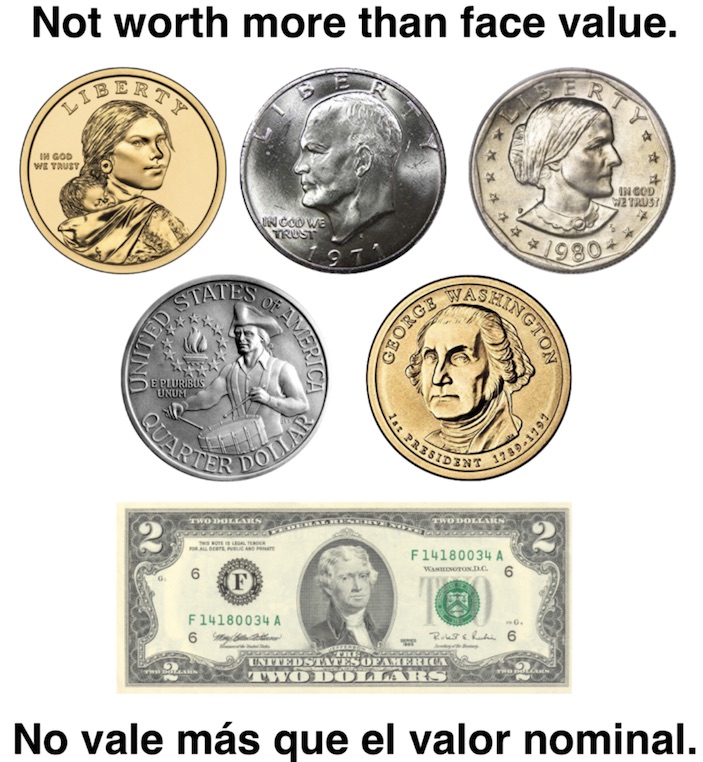
Why We Have This Sign
We have a printed version of this page taped near our transaction window.
The reason may surprise some people.
It is not because we are trying to be rude.
The sign exists because many people have already convinced themselves these items are valuable before they walk through the door.
They have watched videos. They have seen online listings. They have read articles claiming ordinary coins are worth thousands of dollars.
When we tell them their Presidential Dollar is worth one dollar or their Bicentennial Quarter is worth twenty-five cents, some naturally wonder whether we are simply trying to buy it cheaply.
The reality is much less exciting. Most of the items on this page are so common that we have no interest in purchasing them at all. We regularly deposit the same coins and bills at the bank ourselves.
The sign exists because these conversations happen constantly, and because sometimes seeing the answer in writing is more convincing than hearing it from the person standing behind the counter.
The Bicentennial Quarter
The Bicentennial Quarter is probably the most common example on this list. Many people see the dual date of 1776-1976 and assume the coin was somehow made in 1776.
It was not.
These quarters were made to celebrate America’s Bicentennial and were produced in enormous quantities. Most examples found in circulation are still worth 25 cents.
Learn more in our article explaining why most Bicentennial Quarters are only worth face value.
The Presidential Dollar
The Presidential Dollar may be one of the greatest examples of unsuccessful money in American history.
The coins are gold-colored but contain no gold. The dates were placed on the edge where they often wear down. Many people see a gold-colored coin with no obvious date and immediately assume they have found something rare.
In reality, hundreds of millions were produced.
The public largely ignored them, and the government eventually accumulated enormous stockpiles of unwanted dollar coins. Click here to see how bad it got.
Ironically, many Americans rarely saw them in circulation and assumed they were unusual, while people from countries such as Ecuador often considered them perfectly normal money because U.S. dollar coins circulated much more heavily there.
The same coin that looks mysterious to one person may look completely ordinary to another.
The Sacagawea and Native American Dollars
These coins suffer from many of the same problems as the Presidential Dollars. They are gold-colored, unfamiliar to many Americans, and frequently mistaken for something valuable.
They are not made of gold and most examples are worth exactly one dollar.
The Eisenhower Dollar
The Eisenhower Dollar is large, heavy, and impressive-looking. Because of its size, many people assume it must be silver.
Most are not. While some collector versions contain silver, the vast majority encountered by the public are common clad dollars worth face value.
The Susan B. Anthony Dollar
The Susan B. Anthony Dollar was intended to replace larger dollar coins but was often confused with a quarter because of its size and color.
Public acceptance was poor and the series was short-lived.
The Two Dollar Bill
The modern $2 bill is another item that generates endless questions. Many people assume they are rare simply because they do not encounter them very often.
The Bureau of Engraving and Printing still produces them. Most examples are worth exactly two dollars.
Why Different Does Not Mean Valuable
One of the biggest misconceptions in the coin business is that unusual automatically means valuable.
Most of the items on this page are unusual only because they failed to circulate widely. People do not see them often, so they assume they must be rare.
Scarcity and familiarity are not the same thing.
A coin can be unfamiliar without being scarce. It can be old without being valuable. It can look different without being rare.
If you are trying to determine whether something has real collector value, these guides may also help:
- Why Coin Values on the Internet Are Often Misleading
- How to Identify Inherited Coins
- How Much 90% Silver Equals One Ounce of Silver
- Understanding Coin Collections
- Frequently Asked Questions
- Selling Coins
The lesson is simple. Money does not become valuable because it looks unusual. Most valuable coins are valuable because collectors have been searching for them for generations. Most of the items on this page are simply examples of money that never quite caught on.
Related Articles : Why Coin Values on the Internet Are Often Misleading, Are Old Coins Worth a Lot of Money?, Are Old Coins Rare?, Browse All Selling Guides