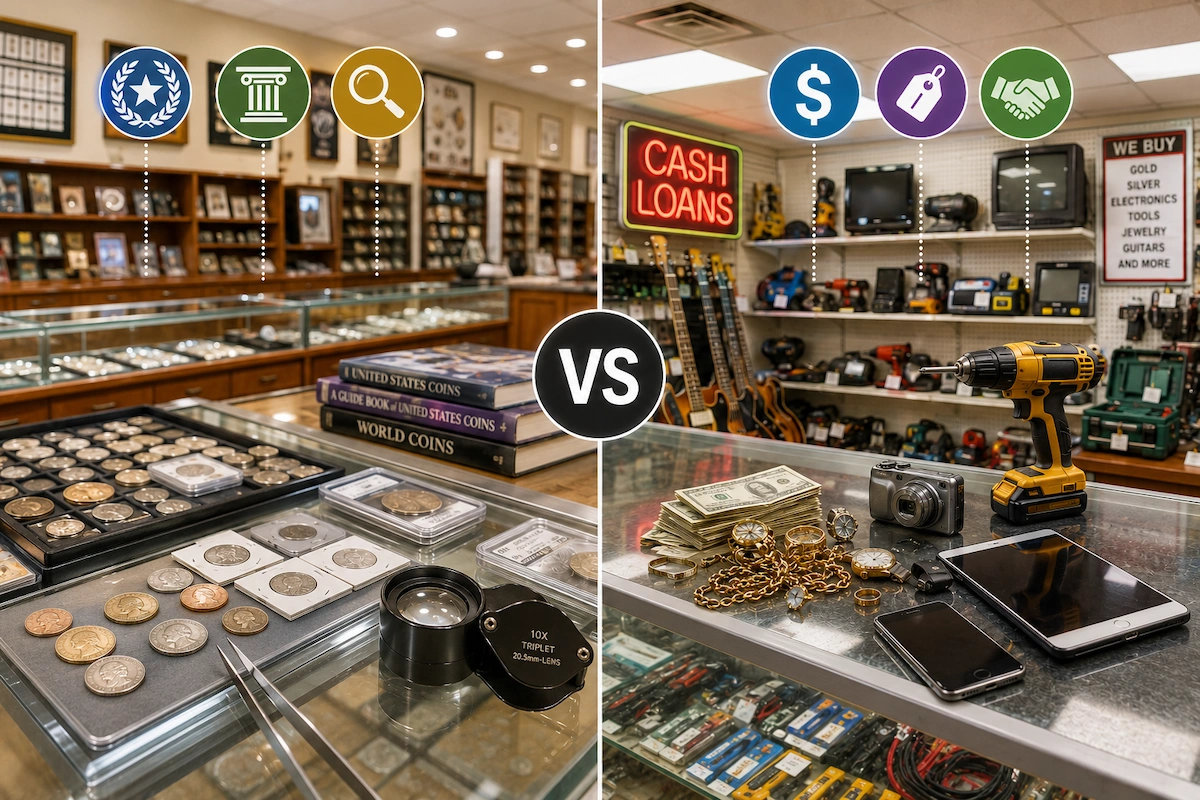
Pawn shops and coin shops sometimes buy some of the same things, but they are not really the same kind of business.
A pawn shop is a general buyer and lender. They may handle jewelry, tools, electronics, musical instruments, watches, collectibles, and many other categories. In smaller towns, a pawn shop may even function almost like a trading post because there may not be many other local options.
A specialized coin shop is different. At Oakton Coins & Collectibles, our business is built around coins, gold, silver, bullion, paper money, jewelry, sterling silver, and estate-related valuables. We are not trying to evaluate televisions, power tools, and coin collections in the same afternoon. This is what we do every day.
 Estate Sellers Are Not Looking for a Loan
One of the biggest differences is the reason a customer walks in.
The traditional pawn shop model is built around loans. A customer brings in an item, receives money against it, and may later redeem the item by paying back the loan and fees.
Estate sellers are usually trying to liquidate assets, not borrow against them.
When someone inherits a coin collection, gold jewelry, sterling silver, paper money, or bullion, they are usually trying to identify what they have, understand what has value, and decide how to divide or liquidate the estate. A loan can complicate that situation. Most estate sellers are looking for answers and a clean sale, not a temporary cash loan against inherited property. Our guide to what happens during an estate appraisal explains how that evaluation process usually works.
Coin Shops Are Built Around Specialized Markets
In a large market like the Chicago area, coins and bullion are specialized businesses. There are active markets for rare coins, common silver coins, gold coins, paper money, modern bullion, proof sets, mint sets, world coins, and many other categories.
A coin dealer is not relying only on local walk-in retail traffic. A specialized dealer has access to collectors, wholesalers, other dealers, grading services, auction channels, precious-metals markets, and long-standing industry relationships.
That matters when a collection is large, unusual, or valuable. Liquidity is not just about having cash available. It is about knowing where the material belongs, how it should be evaluated, and what market will absorb it. That is particularly important with numismatic coins, where rarity, condition, grading, and collector demand can matter far more than metal value alone.
Knowledge Matters Before Price Matters
Many estate sellers do not know exactly what they have. That is normal.
A box from a safe deposit box, closet, basement, or family estate may contain silver coins, modern coins, gold coins, paper money, foreign coins, proof sets, medals, tokens, bullion, jewelry, and items that only look valuable. Before a fair offer can be made, the material has to be identified correctly.
That is where a specialized coin shop is different. We are not just buying metal by weight. We are looking for dates, mint marks, condition, silver content, gold content, collector demand, grading potential, authenticity, and whether an item belongs in the bullion market, collector market, wholesale market, or another estate category.
Pawn Shops Often Overlap More With Jewelry Than Coins
Many pawn shops carry a large amount of jewelry and watches, and some of them may feel closer to jewelry stores than coin shops. That makes sense for their business model because jewelry is easy to display, easy to retail, and commonly used for loans.
Coins and bullion are different. A rare coin collection, a group of silver dollars, a bag of 90% silver coins, a paper money collection, or a large bullion estate requires a different knowledge base and different market access.
Modern coin shops can also handle far more than coins. Our guide to what you can sell to a coin shop besides coins covers many of the jewelry, bullion, paper-money, sterling-silver, and collectible categories that overlap with estate work.
Large Estates Need Liquidity and Direction
A small amount of gold jewelry or silver may be simple to evaluate. A large estate collection can be very different.
Some estates contain a lifetime of coins, bullion, jewelry, sterling silver, paper money, and collectibles accumulated over decades. Those situations require more than a quick glance. They require sorting, identifying, separating, testing, explaining, and sometimes using both in-house knowledge and outside industry relationships.
At Oakton Coins & Collectibles, we regularly help people with inherited coin collections and estate accumulations. For mixed estates containing several different categories, our guide to selling estate valuables in one place explains why dealing with a buyer who understands multiple related markets can simplify the process.
The Bottom Line
Pawn shops and coin shops may both buy certain valuables, but they are built for different purposes.
For an estate seller, the issue is not getting a short-term loan. The issue is understanding what was inherited and finding the right market for it.
If you inherited coins, gold, silver, bullion, paper money, jewelry, sterling silver, or other estate valuables, a specialized shop will give you a clearer path than a general buyer. The right buyer is not just the person willing to purchase the items. It is the person who understands the category, the market, and the estate situation.
Oakton Coins & Collectibles helps customers throughout Chicago and the surrounding suburbs evaluate and sell coins, bullion, precious metals, paper money, jewelry, sterling silver, and estate collections in a straightforward setting.
Related Articles: What Is a Coin Shop?, What Can I Sell to a Coin Shop Besides Coins?, What Happens During an Estate Appraisal?, How Estate Executors Can Sell Coins and Jewelry, One Place to Sell Estate Valuables, Browse All Selling Guides