One question we hear from time to time is why coin shops, gold buyers, jewelers, and precious metal dealers often use pennyweight (dwt) instead of grams.
To someone outside the industry, pennyweight can sound like an old-fashioned or confusing measurement. Most people are familiar with grams, while very few use pennyweight in everyday life.
The reason is actually simple: precious metals are traditionally traded and priced using troy ounces, and pennyweight is part of that same troy-weight system.
Troy Ounces and Pennyweight Work Together
Gold, silver, platinum, and palladium are commonly quoted on precious-metal markets by the troy ounce. This is different from the regular household ounce used for food, shipping, and many everyday measurements. You can read more about that difference in our guide to troy ounces vs. regular ounces.
A troy ounce contains exactly 20 pennyweight.
That means if gold is trading at $4,000 per troy ounce, dividing the troy-ounce price by 20 gives a $200-per-pennyweight value for pure gold before accounting for purity, dealer spreads, refining costs, or other factors.
Because pennyweight and troy ounces belong to the same system, the relationship between the two is particularly simple.
Why Not Just Use Grams?
There’s nothing wrong with grams. In fact, many modern digital scales can display weights in grams, pennyweight, troy ounces, and several other units, and many jewelers and precious-metal businesses routinely use grams.
The difference is that grams are part of the metric system rather than the traditional troy-weight system.
One troy ounce equals approximately 31.1035 grams, while one pennyweight equals approximately 1.555 grams.
The calculation works perfectly well either way. Dealers who are accustomed to pennyweight often prefer it simply because 20 pennyweight equals one troy ounce, making mental calculations particularly easy.
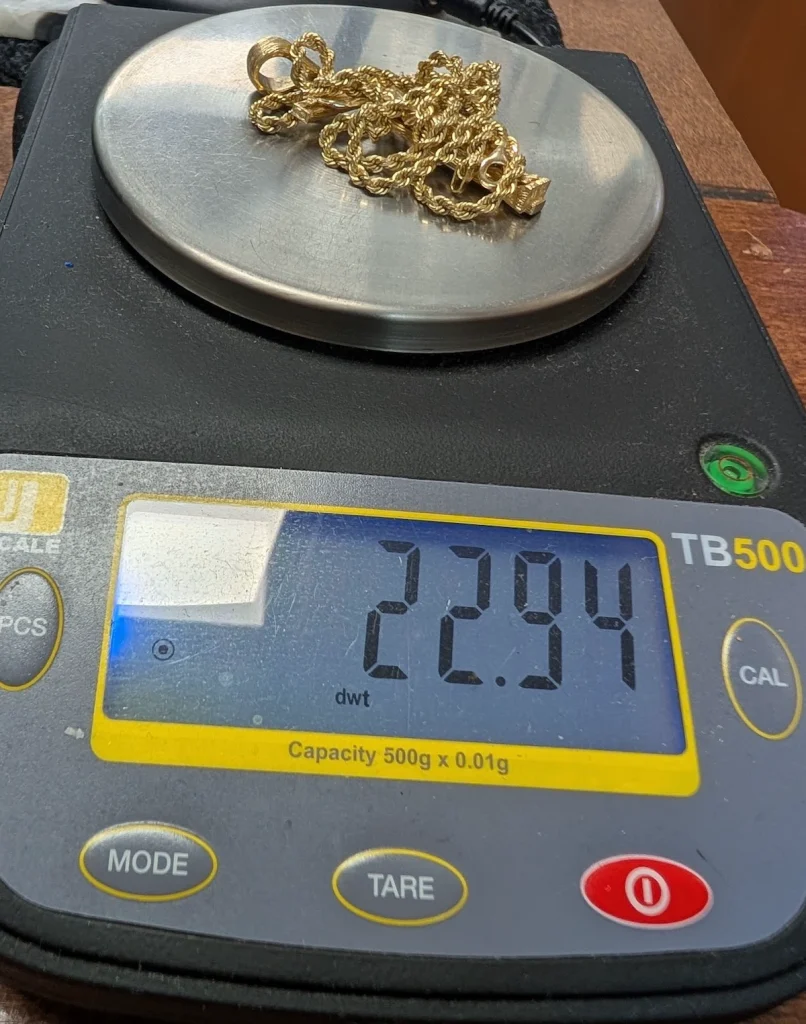
Why Jewelry Buyers Often Use Pennyweight
Pennyweight has a long history in the jewelry, coin, refining, and precious-metals trades. For dealers who have used the system for years, looking at a scale showing 10 dwt or 25 dwt is no more unusual than someone else looking at a scale showing grams.
The unit does not change the amount of gold on the scale. Ten pennyweight is simply another way of expressing approximately 15.55 grams.
This sometimes creates unnecessary confusion when people are selling gold after researching their jewelry in grams online. A gram scale and a pennyweight scale can show very different-looking numbers while describing exactly the same physical weight.
Weight Is Only Part of a Gold Evaluation
Whether jewelry is weighed in grams or pennyweight, weight alone does not determine its value. The purity of the metal also has to be established.
A 10K ring, 14K chain, 18K bracelet, and 24K gold bar can all weigh exactly the same amount while containing very different amounts of pure gold. Stones, non-gold components, clasps, solder, and other materials can also affect an evaluation.
That is why we determine both weight and purity when evaluating jewelry. Learn more about how we test gold and understanding gold karats.
Keeping the Math Simple
When we evaluate gold, silver, platinum, or other precious metals, we’re already working from troy-ounce market prices.
Using pennyweight keeps the calculations straightforward for dealers accustomed to working in the troy-weight system.
If a customer wants to know the weight in grams, the conversion is simple. Modern digital scales can also switch between units. The important thing is not whether the display says grams or pennyweight. The important thing is understanding which unit is being used and making sure the calculation uses that same unit correctly.
The Bottom Line
Pennyweight remains common in parts of the coin, jewelry, gold-buying, and precious-metals industries because it works directly with the traditional troy-ounce system.
It’s not a different kind of weight and it does not change how much gold you have. It is simply another unit of measurement: 20 pennyweight equals one troy ounce, and one pennyweight equals approximately 1.555 grams.
If you’d like to know your item’s weight in grams, pennyweight, or troy ounces, just ask. The value should be the same regardless of which unit is used, provided the conversion and purity calculations are done correctly.
Related: How We Test Gold, Understanding Gold Karats, Gold and Silver Bullion, Spot Gold & Silver Prices, Troy Ounce vs. Regular Ounce.
Related Articles: Troy Ounce vs. Regular Ounce: Why Precious Metals Use a Different Ounce, Why Gold and Silver Dealers Use Spot Price, What Is a Gold Spread?, Browse All Selling Guides