Not necessarily.
One of the biggest misconceptions we hear is that age automatically creates value. Someone finds a coin from the 1800s, or even an ancient coin, and assumes it must be worth a fortune simply because it is old.
That is not how the coin market works.
Age alone does not make a coin rare or valuable.
If age alone created value, every rock outside in the Midwest would be worth a fortune. Many of them are hundreds of millions, or even billions, of years old. Nobody is getting rich selling gravel.
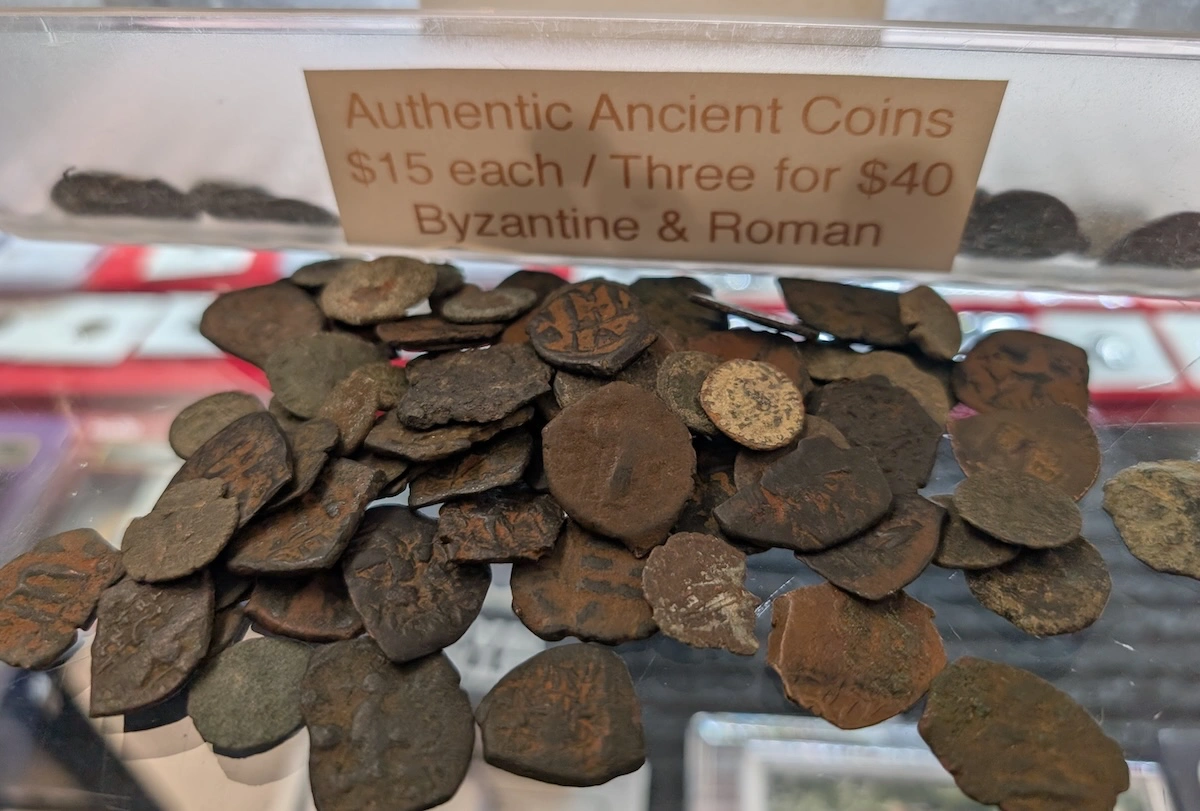
Why Some Very Old Coins Are Not Expensive
Many people are surprised to learn that genuine ancient coins can sometimes be purchased for very modest amounts of money. Some ancient Roman coins are nearly 2,000 years old, but they are not automatically rare.
Part of the reason is simple: ancient societies left behind a lot of coins.
Modern wealth is often digital. Paychecks go into bank accounts. People use debit cards, credit cards, phones, wire transfers, and electronic payments. Two thousand years from now, future archaeologists may find plenty of objects from our time, but much of our wealth may not survive as physical money.
Ancient societies were different. Coins were used for trade, taxes, military pay, savings, and daily commerce. They did not have banking systems like we have today. Because coins were such a major part of economic life, huge numbers were made, buried, lost, saved, and eventually discovered.
That is why a coin can be genuinely ancient and still not be worth a lot of money. Our related guide on whether old coins are worth a lot of money looks more directly at the difference between age and market value.
Americans Have a Different Sense of What “Old” Means
Another reason people overestimate old coins is perspective.
The United States is a relatively young country. We talk constantly about American history, the Civil War, the Revolutionary War, and the founding of the country. In that context, something from the 1800s feels extremely old.
But compared with places like Europe, Persia, the Middle East, China, India, and other older civilizations, a 100-year-old or 150-year-old coin is not ancient at all. In many parts of the world, people live near buildings, roads, ruins, and artifacts far older than the United States itself.
Something can feel old without being rare.
Coin Collecting Has Its Own Timeline
To a 15-year-old, a 1993 quarter is old. To a coin dealer, a 1993 quarter is practically new.
In U.S. numismatics, the timeline is completely different from everyday life. We routinely handle coins from the 1700s, 1800s, and early 1900s. We buy estates containing coins that are 150, 200, or even 2,000 years old. Against that backdrop, a coin from the 1990s simply does not register as old.
In everyday life, a 30-year-old car is old. A 30-year-old computer is obsolete. A 30-year-old television belongs in a museum. In coin collecting, a 30-year-old coin is often something the dealer remembers receiving in change.
The problem is that coin collecting has a different definition of old than the rest of society. In U.S. numismatics, a coin from the 1990s is generally considered modern. When your frame of reference includes colonial coins, Civil War tokens, early American copper, and ancient Roman coins, the 1990s do not feel very long ago.
What Actually Makes an Old Coin Valuable?
Coin value comes from a combination of factors:
- Rarity
- Condition
- Historical significance
- Collector demand
- Metal content
The meaning people attach to a coin matters. A common ancient Roman coin may not be worth very much, even though it is nearly 2,000 years old. Another ancient coin from a historically important culture, ruler, religion, or event may be worth much more because more people want to own that piece of history.
Collectors are not just buying age. They are buying a connection to something they care about.
That is why some early Jewish coins may sell for more than many common Roman coins from a similar time period. The value is not simply the age. It is the history, the meaning, the rarity, and the demand from people who want that specific type of coin.
Even within familiar U.S. series, age alone can be misleading. The 1921 Morgan silver dollar, for example, is more than a century old but is still one of the more commonly encountered Morgan dollars.
Age Is Interesting. It Is Not the Same as Value.
A coin from the 1800s can be common. A coin from the 1900s can be rare. A 2,000-year-old coin can be affordable. A modern coin in exceptional condition can sell for a surprising amount of money.
That is the part many people miss. The date tells us when the coin was made. It does not tell us how many exist, how many people want one, or what condition it is in.
Online listings can make this even more confusing because unusually high asking prices are easy to find. Our guide to why coin values on the internet are often misleading explains why asking price and actual market value are not the same thing.
At Oakton Coins & Collectibles, we look at what the coin actually is, not just how old it is. We evaluate U.S. coins, world coins, ancient coins, silver coins, gold coins, and complete coin collections based on rarity, condition, demand, and market value.
If the coins came from an estate or family collection, our guide to identifying inherited coins can help explain why it is better to evaluate the collection before making assumptions based only on age.
The bottom line is simple: old coins can be valuable, but they are not valuable just because they are old.
Age tells us when something was made. Demand tells us what it is worth.
Related Articles: Are Old Coins Worth a Lot of Money?, Why Coin Values on the Internet Are Often Misleading, Is a 1921 Morgan Silver Dollar Valuable?, Inherited a Coin Collection? Leave It Alone, Browse All Selling Guides