One of the most common questions we hear is, “How long will this take?”
Most people assume a coin appraisal will take hours.
In reality, most appraisals are much faster than people expect.
The reason is simple: experience.
Pattern Recognition Matters
Coin dealers spend years looking at the same coins over and over again. Human beings are remarkably good at recognizing patterns, and this business relies heavily on that skill.
After seeing hundreds of thousands of coins, common silver pieces, proof sets, and bullion products, many items become instantly recognizable.
A customer may be seeing a Morgan dollar or Mercury dime for the first time in years. A dealer may have seen thousands of them this month.
That does not mean we are ignoring the collection. It means we have seen similar items many times before.
Most Collections Are Faster Than People Expect
Many customers walk in expecting an appraisal to take several hours.
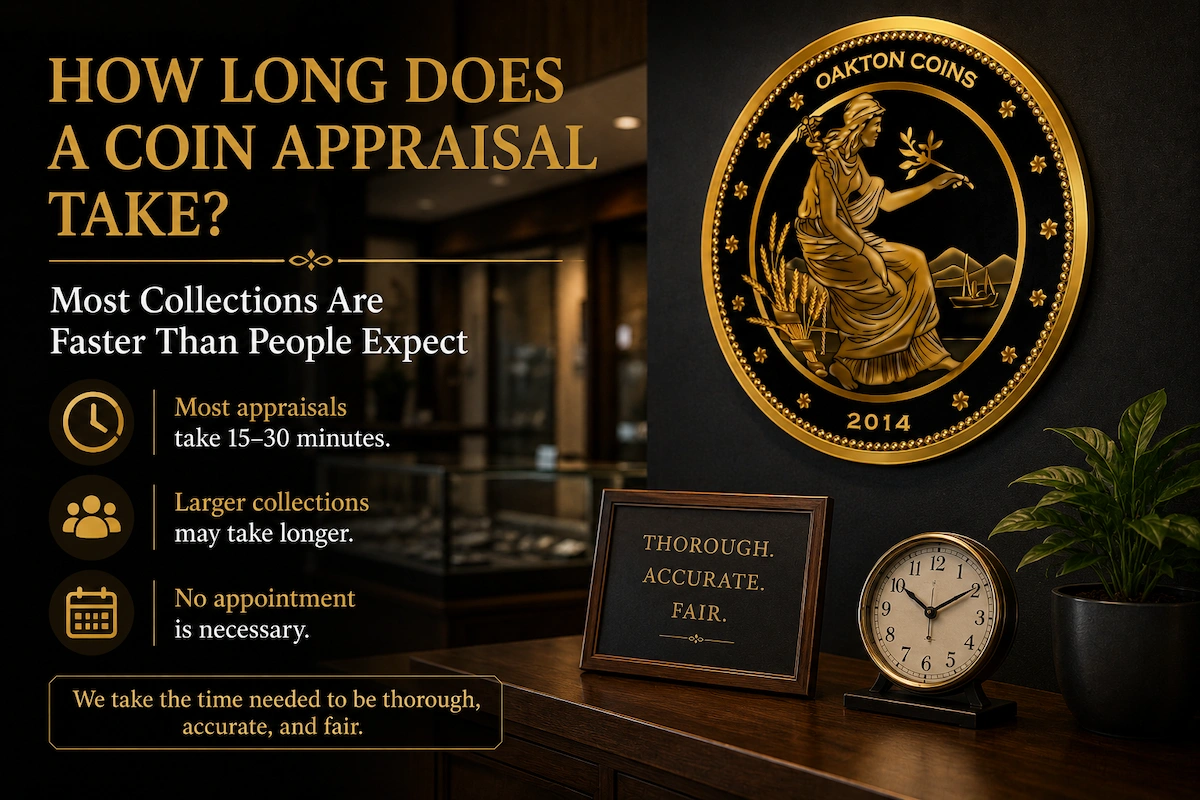
In practice, many collections can be evaluated in a matter of minutes. Even larger collections are often completed much faster than people expect.
The largest collections are not always the slowest. Sometimes a large collection contains mostly familiar items that can be identified very quickly.
The collections that take the longest are often the unusual ones filled with oddball items, mixed collectibles, unfamiliar material, or things we do not see every day.
You also generally do not need to spend hours organizing everything before visiting. Our guide to whether you should sort coins before bringing them to a dealer explains why leaving a collection substantially as you found it is often perfectly fine.
The Coins Are Usually The Easy Part (From Our Perspective)
Ironically, the slowest part of many appraisals is not the coins.
The slowest part is often the conversation.
After years of looking at coins, currency, bullion, and collectibles, much of the identification process becomes pattern recognition. We may have seen similar items hundreds or many thousands of times before.
What takes longer is understanding what the customer is trying to accomplish. Are they selling today? Looking for an appraisal? Settling an estate? Trying to learn more about a collection? Looking for reassurance that they are making the right decision?
Estate situations in particular may involve more discussion because the person bringing the collection in may need information before any decision can be made. Our guide to what happens during an estate appraisal explains that process.
We also need to explain what we are seeing, answer questions, and make sure the customer understands what they have.
In many cases, we can evaluate a collection faster than we can explain it.
The goal is not to rush people. The goal is to make sure they leave with a clear understanding of what they have and what their options are.
Sometimes Fast Answers Make People Nervous
One challenge with experience is that it can make the process look deceptively easy.
Some customers are impressed when a collection is evaluated quickly. Others wonder if enough attention is being given to the items.
Part of our job is making sure people understand that a fast answer is often the result of years of experience, not a lack of interest.
We also spend a considerable amount of time helping people separate realistic values from information they may have seen online. The internet and YouTube can be helpful, but they can also create a great deal of confusion about what is actually rare and valuable. Our article on why coin values on the internet are often misleading explains some of the most common problems.
Inherited Collections Do Not Need to Be Researched First
People who inherit coins often think they should research every date, mintmark, album, and box before visiting a dealer. Usually that creates a great deal of work without making the appraisal significantly easier.
If you inherited a collection, our guide to the best way to bring an inherited coin collection to a coin shop explains how to handle it before your visit. In many cases, the easiest approach is simply to bring the collection in and let us identify the important material.
Do I Need an Appointment?
For most ordinary collections, no appointment is necessary. Customers regularly walk in with coins, bullion, paper money, jewelry, and inherited collections during normal business hours. Only unusually large estates or transactions requiring additional staff generally benefit from advance notice.
You can read more in our guide to selling coins without an appointment.
The Bottom Line
Most coin appraisals take far less time than people expect.
Years of experience allow dealers to recognize common patterns quickly, while unusual items naturally require more attention.
The goal is not to spend the most time possible. The goal is to identify the collection accurately, explain what we are seeing, and make sure the customer understands their options.
Most of the time, the coins are the easy part. The conversation is what takes the longest.
Related Articles: Should I Sort My Coins Before Bringing Them to a Coin Dealer?, Best Way to Bring an Inherited Coin Collection to a Coin Shop, What Happens During an Estate Appraisal?, Why Coin Values on the Internet Are Often Misleading, Can I Sell Coins Without an Appointment?, Browse All Selling Guides