If you are looking for cash for gold in Chicago, Oakton Coins & Collectibles provides professional, in-person evaluations with immediate payment when an offer is accepted. We buy gold jewelry, gold coins, bullion, dental gold, broken jewelry and other precious-metal items at our secure Skokie shop, just minutes from Chicago.
Every item is evaluated individually. Gold jewelry is checked for purity and weight, while coins, bullion, watches, diamonds and designer jewelry are examined for value beyond their gold content. We do not automatically treat everything as recyclable metal.
Walk-ins are welcome. Oakton Coins is open seven days a week and offers free parking, controlled entry and private evaluation rooms. We are located at 4547 Oakton Street in Skokie, less than two blocks from the CTA Yellow Line Oakton stop. View our location and current hours.

Sell Gold Near Chicago With Transparent Testing and Straightforward Pricing
Oakton Coins & Collectibles has served Chicago and the surrounding suburbs since 2014. Our customers regularly visit from Rogers Park, Edgewater, Uptown, Albany Park and other North Side neighborhoods, as well as Skokie, Evanston, Lincolnwood, Morton Grove and Niles.
Our goal is to make selling gold understandable. We explain what we are testing, what we find and how those results affect the offer. There are no pawn loans, interest charges or storage fees. If you decide to sell, the transaction is completed immediately.
What Types of Gold Do We Buy?
We buy gold in many forms, including:
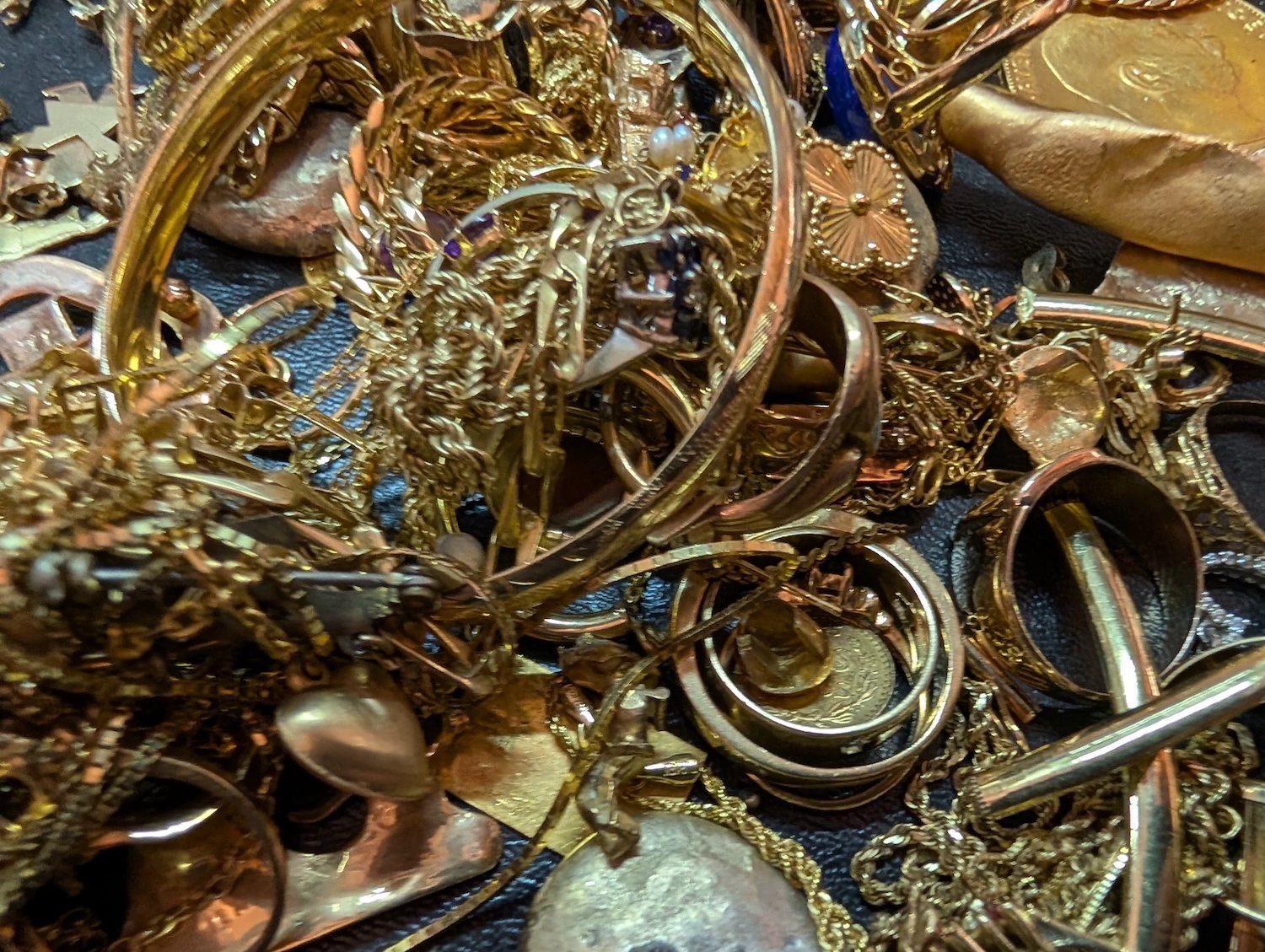
- Gold rings, necklaces, chains, bracelets and earrings
- Broken, tangled, mismatched or unwanted gold jewelry
- 10K, 14K, 18K, 22K and 24K gold
- White gold, yellow gold and rose gold
- Gold watches and watch cases
- Gold teeth, crowns and other forms of dental gold
- American and foreign gold coins
- Gold bars and recognized bullion products
- Estate, antique and designer jewelry
- Gold-filled and gold-plated items for identification, although these contain much less gold than solid-karat jewelry
You do not need to untangle, polish or organize everything before visiting. A mixed group of jewelry is normal. Learn more about the different forms of gold we buy and our evaluation process.
What Happens During a Gold Evaluation?
We begin by separating items according to their apparent metal content and potential resale value. Hallmarks such as 10K, 14K, 18K, 22K, 24K, 417, 585 and 750 are helpful, but a stamp alone does not prove that an item is solid gold or that its stated purity is accurate.
We then examine and test the items using the method appropriate for each piece. Depending on the item, this may include visual inspection, magnet testing, acid testing, accurate weighing and X-ray fluorescence analysis. Oakton Coins has two professional bench XRF analyzers that allow us to examine metal composition without relying solely on a stamp.
When stones, clasps, springs or other non-gold components affect the weight, we explain that as part of the evaluation.
For a closer look at the process, read our guide to professional gold testing.
How Is a Cash Offer for Gold Calculated?
A gold offer begins with four basic factors: weight, purity, the current gold market and the form in which the gold can be resold or refined. The daily spot price is an important reference, but spot is not the same as the cash value of a finished piece of jewelry.
A 14K necklace is not 100% gold. In theory, 14K represents 58.5% pure gold, but actual jewelry can test somewhat differently. Stones, clasps, solder, steel springs and other components may also contribute to the total weight without contributing the same gold value.
An offer must also account for refining, handling, market movement and the time required to convert mixed material into a final settlement. That is why simply multiplying the gross weight by the internet spot price usually produces an unrealistic number.
Our guides explain why spot price is a reference rather than a cash price, what a gold spread means and why some precious-metal dealers use pennyweight instead of grams.
Gold Karat Stamps Can Be Helpful, but They Are Not the Final Answer
Gold purity varies considerably. Ten-karat jewelry contains less gold than 14K, while 18K and 22K pieces contain substantially more. Jewelry marked 14KP uses the word “plumb” to indicate that it is intended to meet the stated 14K standard rather than fall below it.
Some pieces have been repaired with lower-karat solder. Others contain gold-filled components, plated sections or non-gold clasps. Counterfeit stamps also exist. For those reasons, professional testing matters more than a single mark.
Our gold-karat guide explains common stamps and purity levels in greater detail. You can also read about the differences among yellow, white and rose gold.

Gold Coins and Bullion Require a Different Evaluation
Gold coins and bullion should not automatically be priced as ordinary jewelry. A recognized bullion coin may trade according to its gold content and current wholesale demand. An older United States or foreign gold coin may also have collector value beyond its metal content.
Before making an offer, we check the item’s authenticity, weight, condition, denomination, date, mint, marketability and potential numismatic value. This distinction is especially important with pre-1933 United States gold coins, scarce world coins, certified coins and pieces that may have been altered or mounted in jewelry.
Oakton Coins is an authorized dealer for PCGS, NGC and PMG and an APMEX Authorized Dealer. Our coin and bullion experience helps prevent a collectible coin from being treated simply as recyclable gold.
Read more about the difference between selling gold jewelry and selling gold coins, or visit our pages about gold bullion and precious-metal bullion.
Stones, Designer Names and Estate Jewelry May Add Value
Not every piece should be purchased strictly for its gold content. Diamonds, quality gemstones, desirable makers, antique construction and recognizable designer names can sometimes add resale value. Other stones may have limited secondary-market demand even though the original jewelry appraisal or replacement price was high.
We examine the entire piece before deciding how it should be valued. When appropriate, jewelry is considered as a wearable or collectible item instead of being valued only for its metal.
Learn more about estate and designer jewelry and what happens when you sell gold jewelry containing gemstones.
Why We Usually Cannot Quote Gold Jewelry Over the Telephone
Two necklaces that appear similar in a description or photograph can have very different weights, purity levels, clasps, stones and construction. Gold prices can also move while the market is open. Without examining and testing the item, a telephone quote would be little more than a guess.
We prefer to provide a meaningful offer after seeing the actual items. Verbal evaluations are free, and there is no obligation to sell. Written appraisals can also be prepared when needed for estates, insurance or other formal purposes.
Why Chicago Customers Visit Oakton Coins in Skokie
Driving downtown with valuable gold or jewelry is not always convenient. Parking can be expensive, traffic can be unpredictable and carrying valuables through a crowded commercial area may feel uncomfortable.
Oakton Coins offers a safer, simpler alternative just outside Chicago. Our shop has free parking in front and behind the building, a controlled dual-buzzer entrance, 360-degree security cameras and private rooms for larger or more confidential evaluations. When requested, a staff member can escort a customer back to a vehicle after a transaction.
We are near I-94 and easily reached from Chicago’s North Side. Customers using public transportation can take the CTA Yellow Line to the Oakton stop. See why many Chicago residents choose Oakton Coins.
Oakton Coins Is Not a Pawn Shop
We purchase items directly. We do not make loans against jewelry, charge interest or collect storage fees. You receive an offer after the evaluation, and you decide whether you want to sell.
A pawn shop may be appropriate for someone seeking a short-term loan while attempting to recover the same item later. A direct sale is different. Read our comparison of a coin and precious-metal dealer versus a pawn shop.
What Should You Bring When Selling Gold?
- Bring the items exactly as they are; cleaning is unnecessary.
- Bring current photo identification.
- Include boxes, receipts, certificates or prior appraisals if you have them, but they are not required.
- Bring related pieces together when possible, especially with matching jewelry or inherited groups.
- Do not remove stones or disassemble jewelry before the evaluation.
- If you have an unusually large bullion transaction, contact us before visiting so it can be handled during market hours.
Walk-ins are welcome for ordinary transactions. There is no charge for a verbal evaluation and no obligation to accept an offer.
Do You Pay Cash for Gold Immediately?
If you accept our offer, payment is made immediately. The appropriate form of payment can depend on the transaction’s size and circumstances. We do not require you to leave ordinary gold jewelry for days while waiting for an outside party to determine whether an offer will be made.
Do You Buy Broken or Unwanted Gold Jewelry?
Yes. Broken chains, single earrings, bent rings, damaged bracelets, outdated jewelry and pieces that have spent decades in a drawer may still contain substantial gold value. Condition matters less when an item is being evaluated primarily for its precious-metal content.
See additional information about selling broken jewelry and how broken gold is evaluated.
Do You Buy High-Karat Gold?
Yes. We buy 18K, 21K, 22K and 24K gold as well as more familiar 10K and 14K jewelry. High-karat jewelry is common in many parts of Europe, Asia, the Middle East and Latin America. It should be tested carefully because construction methods and purity can vary.
You do not necessarily need to visit a specialty district to sell it. Read more about selling high-karat gold in the Chicago area.
Should I Sell My Gold Now or Wait?
No dealer can reliably predict the future price of gold. The right decision depends on why you own the items, whether you use them, your financial needs and whether the current offer is satisfactory to you. We can explain what the items are and what we would pay today, but the final timing decision belongs to you.
Our guide about whether to sell gold now or wait discusses the decision without pretending that anyone knows the next market move.
Why Choose Oakton Coins as Your Chicago-Area Gold Buyer?
- Serving the Chicago area since 2014
- Open seven days a week
- Walk-ins welcome
- Two professional bench XRF analyzers
- Gold, jewelry, coin and bullion expertise in one location
- PCGS, NGC and PMG Authorized Dealer
- APMEX Authorized Dealer
- ANA life member
- Free verbal evaluations with no obligation to sell
- Immediate payment when an offer is accepted
- Free parking and convenient CTA access
- Controlled entry and private evaluation rooms
- No pawn loans, interest or storage fees
You can review our professional affiliations and accreditations, read customer reviews or learn more about Oakton Coins & Collectibles.
Visit Oakton Coins & Collectibles
Oakton Coins & Collectibles
4547 Oakton Street
Skokie, Illinois
(224) 563-5684
Oakton Coins serves customers throughout Chicago and the surrounding northern suburbs. Walk-ins are welcome, and free parking is available. For directions and current business hours, visit our location page.
Plan your visit to sell gold near Chicago or return to our Chicago coin and gold buyer page.