People often ask us whether they should hold onto something because it might be worth more in the future. Sometimes they mean a coin, a stamp collection, a piece of art, a diamond, an antique, a fur coat, a Chinese artifact, a box of old toys, or even a cryptocurrency. The object changes, but the question is usually the same: Will people pay more for this someday?
The honest answer is that long-term value is not entirely up to the people who own an object today. It will be decided by the people who want to buy it tomorrow.
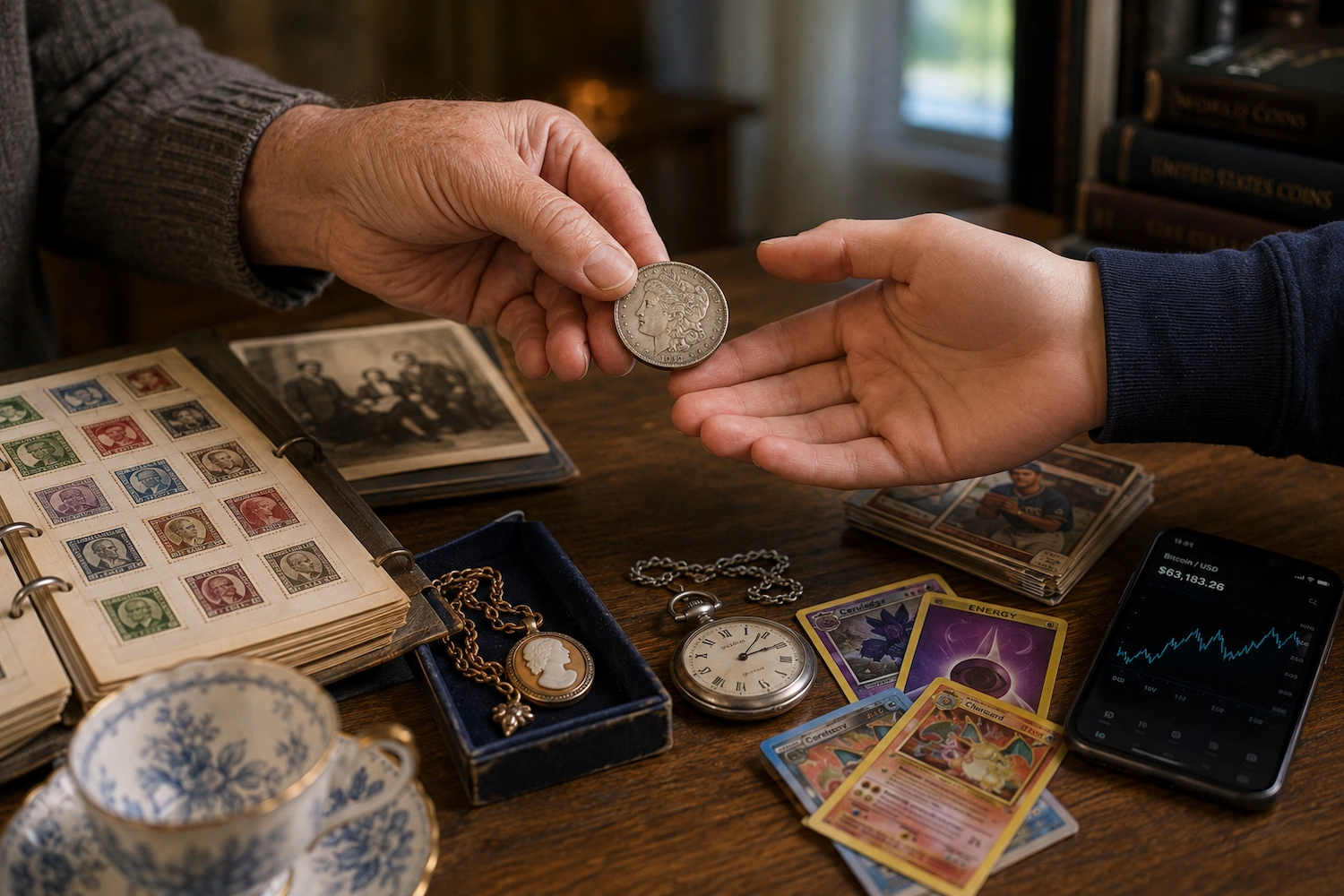
An object does not decide its future value. The next generation of buyers does.
That sounds obvious, but it explains a great deal about why markets rise, fall, and sometimes disappear. People naturally assume that age creates value. They may believe that something old will become more valuable simply because another 50 or 100 years have passed. Age can matter, but age alone does not create rarity or value, especially when future buyers no longer care about the object.
A stamp collection does not automatically become valuable because it sits untouched for another century. Its future price depends on whether people living a century from now still want to collect stamps. We can make predictions, but those buyers may not even be born yet.
Every Generation Chooses Its Own Collectibles
Every generation inherits objects that mattered deeply to the people who came before them. It also creates its own interests, habits, fashions, and forms of nostalgia.
Stamp collecting was once one of the most popular hobbies in the country. Stamps arrived in the mail every day. Children could collect them inexpensively, learn geography and history, and trade them with friends. Millions of albums were assembled during the twentieth century.
The stamps themselves did not change. The world around them did.
People send fewer letters. Children have less everyday contact with postage stamps. Many older collections are entering the market at the same time that fewer new collectors are beginning the hobby. That creates a simple problem: there are more stamp collections available than there are people who want to buy them. Our guide to why the stamp market is different from the coin market looks more closely at this change in collector demand.
A well-organized album may represent years of careful work and personal enjoyment, yet still have very little resale value. That does not mean the collection was foolish or meaningless. It means the next generation did not adopt the hobby in the same numbers.
Why Pokémon Became Valuable
Pokémon cards followed a very different path. Millions of children grew up playing the games, watching the television series, trading cards, and arguing about their favorite characters. Those children eventually became adults with jobs and disposable income.
They did not need to be taught why Pokémon mattered. They already understood it emotionally.
That does not mean every Pokémon card is valuable. Most are common, just as most stamps, coins, and collectibles are common. But strong demand developed because an entire generation carried its childhood interest into adulthood.
The cards did not suddenly become better pieces of cardboard. The buyers changed.
The China Cabinet Problem
We sometimes meet people who are surprised that younger buyers do not want large china cabinets, formal dining sets, silver-plated serving pieces, or complete sets of fine china. They may look at the quality of the workmanship and reasonably ask how something so expensive and well made can now be difficult to sell.
The answer is usually not about quality. It is about lifestyle.
Many younger people are struggling to buy homes. They may live in apartments, move frequently, have less storage space, entertain more casually, and have little use for a large piece of furniture designed to display dishes they rarely use.
The cabinet may still be beautiful. It may have been expensive. It may have served a family well for generations. None of those things creates a buyer who has the room or desire to own it.
People can become disconnected from younger generations and still be confused when the market changes. They know that younger people do not mail many letters, yet wonder why stamp collecting is declining. They know younger people are having difficulty buying houses, yet wonder why no one wants a large dining room set.
Markets are not passing judgment on the objects. They are reflecting the lives of the buyers.
Fur Coats, Diamonds, and Changing Values
Fur coats were once powerful symbols of wealth, fashion, and status. Many were extremely expensive. Today, changes in fashion, climate, social attitudes, and consumer preferences have reduced demand for many types of fur.
The coat did not lose its original craftsmanship. The culture surrounding it changed.
Diamonds are another interesting example. For generations, natural diamonds were strongly connected to engagement rings, permanence, and social expectations. Today, younger buyers have more choices. Lab-grown diamonds have changed pricing. Some couples prefer different stones, simpler rings, or no traditional engagement ring at all.
Natural diamonds remain desirable, particularly when they have exceptional quality, size, rarity, or provenance. But it is dangerous to assume that future buyers will think exactly as previous generations did.
Markets built partly on tradition depend on future generations continuing that tradition.
Art Is Valuable Because People Continue to Care
Art makes the same principle especially visible. A painting has no automatic market price simply because it is old, attractive, or signed. Its value depends on the artist, authenticity, history, quality, cultural importance, and—most importantly—the existence of buyers.
Artists move in and out of fashion. Some are rediscovered decades after their deaths. Others were highly regarded during their lifetimes but later attracted less interest. Museums, scholars, galleries, wealthy collectors, and cultural movements can all influence which artists future generations consider important.
Predicting the art market far into the future means predicting future taste. That has never been easy.
Chinese Artifacts and the Return of Cultural Demand
Chinese antiques and artifacts demonstrate how changes in wealth and cultural interest can transform a market. Objects that once circulated inexpensively outside China sometimes became far more desirable as Chinese buyers gained wealth and sought to recover pieces connected to their own history.
The artifacts did not become older overnight. A new and financially powerful group of buyers entered the market.
This is one reason provenance, authenticity, legal ownership, and cultural importance can matter so much. The future buyer may see an object very differently from the person who currently owns it.
Ancient Coins Have Survived Many Generations
Ancient coins have remained collectible for centuries because they connect people directly to civilizations that no longer exist. A person can hold a coin used during the Roman Empire, ancient Greece, Byzantium, or another long-vanished society.
That historical connection has repeatedly attracted new generations of collectors.
Even so, not every old coin is valuable. Many ancient coins were produced in enormous numbers. Condition, rarity, historical importance, authenticity, and demand still matter. Ancient does not automatically mean expensive.
The important point is that ancient coins have repeatedly found new buyers. Their market has survived because later generations continued to find meaning in them.
Gold Is Different, but It Is Not Immune to Markets
Gold occupies an unusual position because it is both a material and an idea. It has been used as jewelry, money, wealth, decoration, religious symbolism, and a store of value across many civilizations.
Generation after generation has independently decided that gold is desirable.
That long history does not guarantee that gold will rise every year or that every purchase will be profitable. Gold prices move. Economic conditions change. Currencies, interest rates, government policies, mining supply, investment demand, and global events all affect the market.
Still, gold has an advantage that most collectibles do not have. Its appeal does not depend entirely on one hobby, one character, one artist, one fashion, or one generation’s nostalgia. Gold has repeatedly survived changes in culture because new societies and new buyers continued to value the metal.
Its history provides evidence of lasting demand, but evidence is not the same as certainty.
Crypto and a Generation Raised Online
Cryptocurrency would have been difficult for earlier generations to imagine. It reflects a world in which people communicate, work, shop, invest, and build communities online.
Many younger buyers are comfortable assigning value to something digital because much of their lives already exists in digital form. To someone raised before the internet, that can feel strange. To someone raised with the internet, it may feel completely natural.
Crypto prices can be extremely volatile, and no one knows which individual projects will survive. But the broader phenomenon demonstrates the same principle: a new generation can assign enormous value to something the previous generation barely understands.
Future buyers do not need our permission to value something differently.
Should You Hold Something for 100 Years?
When someone asks whether they should hold an object for another 100 years, they are really asking a much harder question:
What will people who are not yet born want to own?
We can study history. We can examine rarity, quality, usefulness, cultural importance, supply, and current demand. We can look for objects that have already remained desirable across several generations. Those things may help us make an educated prediction.
But no one can know future taste with certainty.
Imagine someone in 1926 trying to predict what people would collect in 2026. They might have understood gold, coins, art, books, and antiques. They could not easily have predicted Pokémon cards, sealed video games, internet domains, digital art, or cryptocurrency.
Trying to predict value 100 years from now is not merely predicting the future of an object. It is predicting future housing, technology, wealth, culture, ethics, fashion, nostalgia, and daily life.
Personal Value and Market Value Are Not the Same
None of this means that people should keep only things with strong resale value.
An object can have enormous personal value and very little market value. A stamp album may represent time spent with a parent. A piece of furniture may have stood in a family home for generations. A coin may remind someone of a grandparent. A work of art may simply make its owner happy.
Those are legitimate reasons to keep something.
The mistake is assuming that emotional value automatically transfers to the next buyer. A stranger is not purchasing your memories. The market price is based on what the object means to them.
The Future Belongs to the Buyer
Objects do not create their own markets. Buyers do.
A collectible can be rare and still have little value if few people want it. Something produced in large numbers can become expensive if demand grows faster than supply. A beautifully made object can become difficult to sell because modern lifestyles no longer have a place for it. An ordinary childhood item can become valuable when millions of adults want to recover a piece of their past.
That is why long-term value cannot be determined only by age, original cost, craftsmanship, or what the current owner believes something should be worth.
An object does not decide its future value. The next generation of buyers does.