When the United States struck its first silver dollars in 1794, the silver did not come from an American mine. Much of it came from foreign coins deposited at the newly established United States Mint, melted down, refined, and transformed into a new national currency.
That means some of the most famous coins in American history began as money from another country. The story of the 1794 Flowing Hair silver dollar is not only about a rare coin. It is also the story of a young country trying to create a working monetary system from the collection of foreign coins already circulating within its borders.
What Money Did Americans Use Before U.S. Coins?
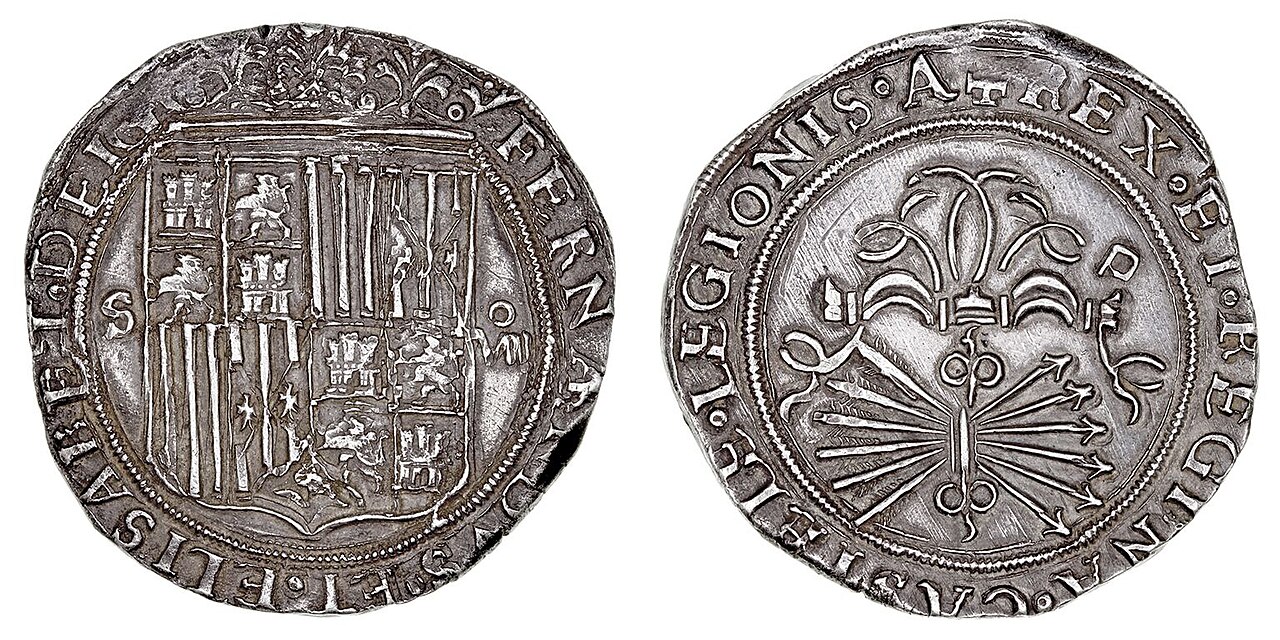
Before the United States had a functioning national mint, Americans used a mixture of foreign coins, colonial issues, privately produced tokens, and paper money. Spanish silver dollars were especially important and circulated widely throughout the colonies and the early United States.
The Spanish dollar was commonly known as a “piece of eight” because it was divided into eight reales. One real was sometimes called a “bit,” which is where the old expression “two bits” for twenty-five cents originated.
French, British, Dutch, Portuguese, and other foreign coins could also be found in circulation. Their values were often determined by their weight and precious-metal content rather than simply by the denomination stamped on the coin.
This confusing collection of currencies made everyday commerce more complicated. The country needed a standardized national system based on coins of known weight, purity, and value.
The Coinage Act of 1792 Created the U.S. Mint
Congress passed the Coinage Act of April 2, 1792, formally establishing the United States Mint and creating a decimal monetary system based on dollars, dimes, and cents.
The law authorized a surprisingly broad range of coins:
- Half cents
- One-cent coins
- Half dismes, later spelled half dimes
- Dismes, later called dimes
- Quarter dollars
- Half dollars
- Silver dollars
- Gold quarter eagles
- Gold half eagles
- Gold eagles
The silver dollar was intended to contain roughly the same amount of silver as the widely accepted Spanish milled dollar. This helped make the new American dollar understandable and acceptable to merchants who were already familiar with Spanish coinage.
The first federal Mint was built in Philadelphia, which was then the nation’s capital. Although the Mint existed on paper in 1792, producing large quantities of uniform coinage was much more difficult than simply passing a law.
Where Did the First U.S. Mint Get Its Silver?
The early Mint did not normally own the gold and silver it turned into coins. Under the system established by Congress, private individuals, merchants, and banks could deposit bullion or foreign coins at the Mint. The metal would be tested, refined when necessary, and converted into United States coins.
One of the earliest and most important silver deposits was made by the Bank of Maryland in July 1794. The deposit was valued at approximately $80,715 and consisted largely of French silver coins.
Those coins were not simply stamped over with an American design. They were melted into bullion, assayed to determine their purity, refined, mixed to the required standard, rolled into strips, and cut into planchets suitable for striking.
In a very literal sense, foreign money became American money.
Why Were French Coins Melted Down?
The United States did not yet have a major domestic silver-mining industry capable of supplying the new Mint with a steady stream of metal. However, foreign silver coins were already present in large numbers through international trade.
A bank holding foreign coins could continue using them as they were, or it could deposit them at the Mint and receive standardized United States coinage in return. Converting foreign coins into American dollars helped the government establish confidence in the new monetary system.
The process also gave the young country a practical way to create national coinage without waiting for large new sources of American silver to be discovered.
The Silver Required Considerable Refining
The French coins deposited by the Bank of Maryland reportedly averaged only about .737 fine silver. The standard required for the new United States silver coins was considerably higher, so the metal had to be refined before it could be used.
Early Mint workers separated impurities and adjusted the alloy before rolling the silver into sheets. Round blanks were then punched from the sheets, weighed, adjusted when necessary, and prepared for striking.
This was slow, physical work performed with machinery that was primitive by modern standards. Every stage presented opportunities for errors, including uneven planchets, weak strikes, adjustment marks, and inconsistent surfaces.
Collectors today sometimes view these characteristics as defects, but they are also evidence of the difficult conditions under which America’s earliest coins were produced. Our numismatic glossary explains many of the terms used to describe coin production, condition, grading, and surface characteristics.
The First U.S. Silver Dollars
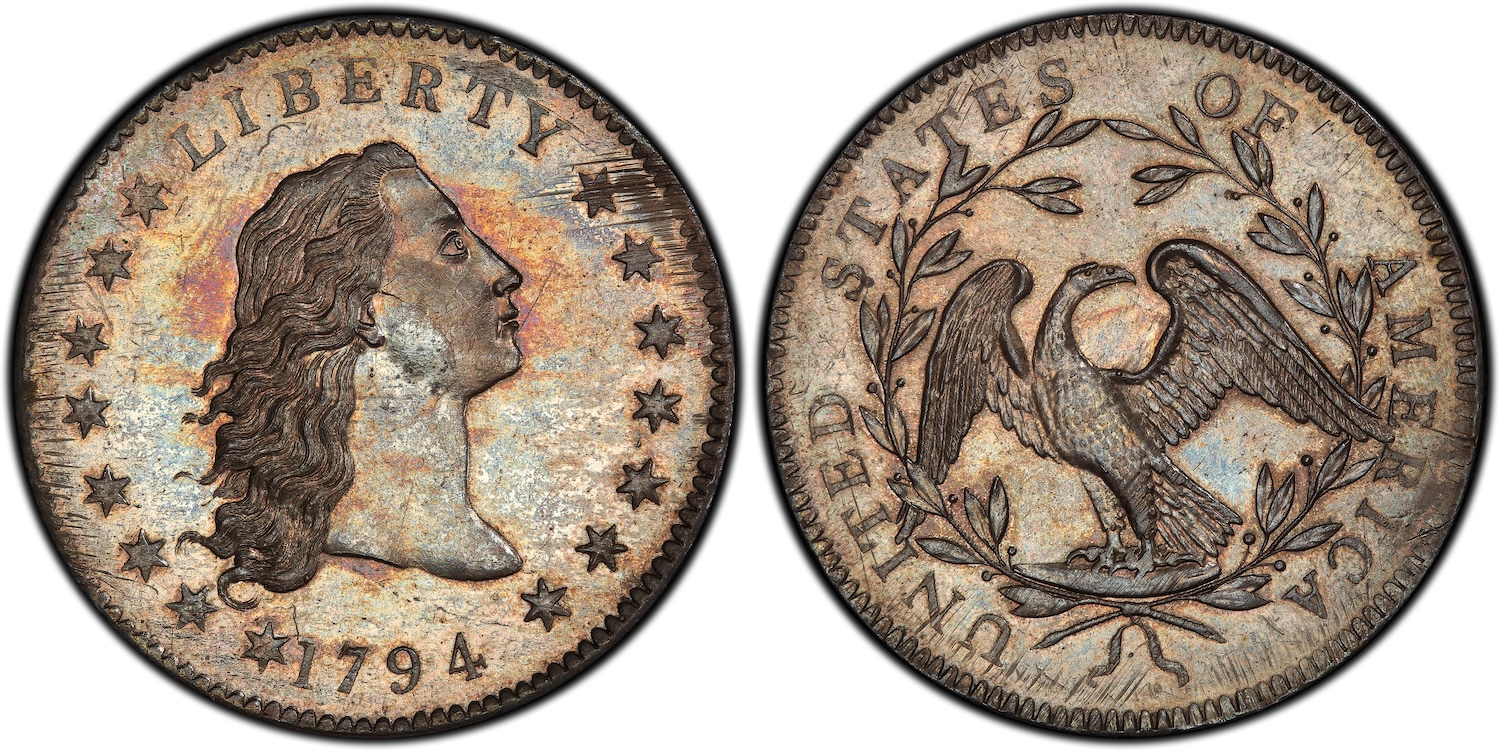
On October 15, 1794, the Mint delivered 1,758 Flowing Hair silver dollars. These are generally recognized as the first silver dollars officially issued by the United States government.
The obverse features Liberty with flowing hair, while the reverse shows a small eagle surrounded by a wreath. The design was created by Mint engraver Robert Scot.
The coins were struck on a press that was better suited for smaller denominations. As a result, many 1794 dollars display weakly struck areas, especially near the left side of the obverse and corresponding portions of the reverse.
Not all of the 1,758 coins were necessarily released into circulation immediately. Some apparently failed to meet the Mint’s expectations, and surviving examples vary considerably in sharpness and overall appearance.
Today, the 1794 Flowing Hair dollar is one of the most famous and valuable United States coins. A particularly important example believed by some researchers to have been among the first struck has sold privately for millions of dollars.
The Same Silver Was Used for Early Half Dollars
The Bank of Maryland deposit was not used only for silver dollars. Silver from the deposit was also used in the production of 1794 Flowing Hair half dollars.
The half dollar was an important denomination in early American commerce. Unlike the silver dollar, which was large and somewhat difficult for the early Mint to strike, the half dollar was better suited to the available equipment and eventually became one of the principal silver coins produced by the Mint.
Early half dollars can be valuable, but value depends heavily on date, variety, condition, originality, and whether the coin has been cleaned, damaged, repaired, or altered. Anyone trying to identify older American coins may find our guide to identifying inherited coins helpful.
Were the First American Silver Coins Really American?
Politically and legally, they were absolutely American. They were authorized by Congress, produced at the Philadelphia Mint, and struck with designs representing the new republic.
The metal itself, however, had already traveled through an international economy. It may have been mined in the Americas, shipped to Europe, made into French coins, transported back across the Atlantic, deposited in an American bank, and finally melted at the United States Mint.
That complicated journey illustrates how interconnected the eighteenth-century economy already was. Coins routinely crossed borders and continued circulating far from the countries that issued them.
Foreign Coins Remained Legal Tender for Decades
Establishing the United States Mint did not immediately remove foreign coins from circulation. The Mint initially lacked the capacity to produce enough coins for the entire country, so Congress continued recognizing certain foreign coins as legal tender.
Spanish and Mexican silver dollars remained especially common. Foreign silver coins continued circulating legally in the United States until the middle of the nineteenth century, with Congress finally ending their legal-tender status in 1857.
For several generations, Americans could therefore encounter a mixture of United States coins and older foreign silver in ordinary commerce.
Why the Story Matters to Coin Collectors
The history of the first silver dollars demonstrates that a coin is more than a manufactured object. Its metal, design, production methods, circulation, and survival can each tell a different part of the story.
A 1794 silver dollar represents:
- The creation of the United States monetary system
- The transition from foreign coins to national coinage
- The early operation of the Philadelphia Mint
- The technical limitations of eighteenth-century coin production
- The international movement of silver
- The efforts of a new government to establish public confidence
Those layers of history are a major reason early United States coins remain so appealing to collectors.
Not Every Old Silver Dollar Is Rare
The extraordinary value of the 1794 dollar sometimes creates unrealistic expectations about other silver dollars. Most silver dollars encountered in inherited collections are much later Morgan dollars or Peace dollars. These coins can certainly have value, but old coins are not automatically rare simply because of their age.
Coin values depend on several factors, including rarity, date, mintmark, grade, collector demand, surface quality, and precious-metal value. Online asking prices can be especially misleading because anyone can list a coin at almost any price. Our article on why internet coin values are often misleading explains the difference between asking prices and actual market value.
It is also important not to clean old coins. Cleaning can permanently alter their surfaces and greatly reduce their collector value. If you inherited a coin collection, leaving the coins alone until they have been properly identified is usually the safest approach.
Selling an Early U.S. Coin or Coin Collection
Oakton Coins & Collectibles evaluates and purchases United States coins, world coins, paper money, and complete collections. We regularly work with longtime collectors, families handling inherited collections, estate representatives, and people who simply discovered older coins stored away for many years.
Some coins are worth primarily their silver content, while others carry significant numismatic value. Proper identification matters because rare dates, varieties, and higher-grade coins should not be treated as ordinary bullion.
Our shop is built around numismatic evaluation rather than simply weighing everything for melt value. Learn more about how to sell coins and coin collections in the Chicago area, browse our collection of coin and precious-metal selling guides, or review the broader range of items we buy.
Oakton Coins & Collectibles is located at 4547 Oakton Street in Skokie, Illinois. We are open seven days a week, and most customers do not need an appointment.
Sources and Further Reading
- United States Mint: Coinage Act of April 2, 1792
- National Archives: Records of the United States Mint
- PCGS CoinFacts: 1794 Flowing Hair Dollar
- Stack’s Bowers: 1794 Flowing Hair Dollar
- Library of Congress: Founding of the United States Mint